



Significance of 'harmony and peace' far beyond Chinese festival culture









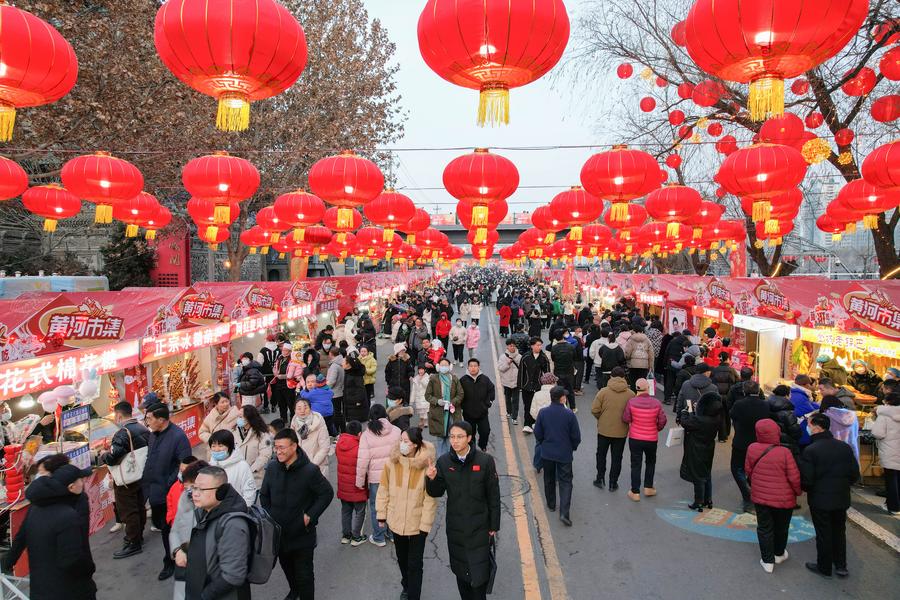
The Lantern Festival, also known as Yuanxiao Festival, is a traditional Chinese festival celebrated on the fifteenth day of the first month in the lunar calendar, which marks the end of the Spring Festival. During this time, people gather to appreciate colorful lanterns, solve riddles, and enjoy sweet glutinous rice balls known as "yuanxiao". This year, the Lantern Festival will fall on Saturday.
The culture of "harmony and peace", embedded in the customs and tradition of Spring Festival, represents the spiritual core of Chinese culture. This cultural ethos provides valuable guidance in navigating relationships between individuals and nature, families, and society at large.
The Chinese people value the harmonious relationship between humans and nature, which is reflected in the traditional Chinese principle of "Unity of Heaven and Man" and lies at the core of the Chinese Lunar New Year celebration. Ancient Chinese philosopher Lao Tzu said: "Man is modeled on Earth, Earth on heaven, heaven on Tao, and Tao on nature." Therefore, traditional Chinese culture views humans as an integral part of nature, and attaches great value to harmony between humans and nature.
For millenniums, the Chinese people have been observing Spring Festival to express their gratitude to Mother Nature for her bountiful gifts, pray for favorable weather and a fruitful harvest in the new year, and look forward to a prosperous and happy year.
Spring Festival culture also underlines the importance of family harmony and reunion. The yearning for family reunion is manifested in the travel rush, when China witnesses the largest internal human migration in the world with hundreds of millions of Chinese people traveling across the country to their hometown for the family reunion dinner. Customs such as honoring ancestors, having the family reunion meal, and gifting red envelopes with lucky money, reflect the Chinese belief in family values and the pursuit of concord, thereby fostering filial piety and love for the young.
In addition, the inclusiveness of Chinese culture encapsulated in a range of Spring Festival customs and rituals contributes to social peace and cooperation. Not to mention the vast river of Chinese culture is primarily nourished by the tributaries of Confucianism, Taoism and Buddhism.
The diverse customs and rituals observed by the Chinese people during Spring Festival reveal the spiritual essence of Chinese culture: harmony without uniformity. This approach allows for the exploration of common ground while respecting individual differences, thus playing a crucial role in maintaining social peace and facilitating cooperation.
The culture of "harmony and peace" has deeply influenced China's foreign policy. Since Chinese culture is shaped by the idea of "harmony without uniformity", its foreign policy places great emphasis on multilateralism, cooperation, consultation and win-win development in global affairs.
The concepts of "a harmonious world" and "a community with a shared future for humankind" proposed by China are based on the idea of "harmony without uniformity". By coexisting harmoniously, countries can thrive together, and address their differences.
The idea of "harmony and peace" is embedded in Spring Festival celebration, for it helps address many common problems facing countries across the world. Applauding Chinese traditional culture, Bertrand Russell once said that he believes it possesses "something of the ethical qualities in which China is supreme, and which the modern world most desperately needs".
Climate change, ecological crises and pollution are among the most pressing challenges facing the world today. The concept of green development, inherent in the notion of harmony between humans and nature, offers a promising approach to the international community to cope with these issues and forge a healthy and beautiful world.
In addition to the aforementioned environmental problems, humanity also faces regional conflicts, dreadful wars, anti-globalization movements and other challenges. At the root of these issues lies a lack of tolerance between different civilizations and countries, often fueled by extremism. Therefore, the Chinese philosophy of "harmony in diversity" is needed more than ever before.
Countries with different civilizations and systems should seek common ground while setting aside their differences, recognizing each other's legitimacy and respecting their respective differences. Only in this way can mutual respect, cooperation and win-win outcomes be achieved to jointly tackle the series of challenges facing humanity.
The Universal Declaration on Cultural Diversity of UNESCO says, "Cultural diversity is as necessary for humankind as biodiversity is for nature." As a proponent of cultural pluralism, China consistently emphasizes the significance of dialogue and exchanges among diverse cultures and civilizations by adhering to the principles of diversity, tolerance and inclusiveness.
With Spring Festival having been officially listed by the UN General Assembly as a UN floating holiday since 2024, the value of "harmony and peace" and the philosophical concept of "harmony in diversity" exemplified in the Spring Festival culture will gradually be recognized and accepted by the world, which in turn will promote global peace and development, thus benefiting humanity as a whole.
The author is a professor at and director of the Center for Global Governance and Law, Xiamen University of Technology.
The views don't necessarily reflect those of China Daily.





