



Guide tells how corridor paved way for historical footsteps









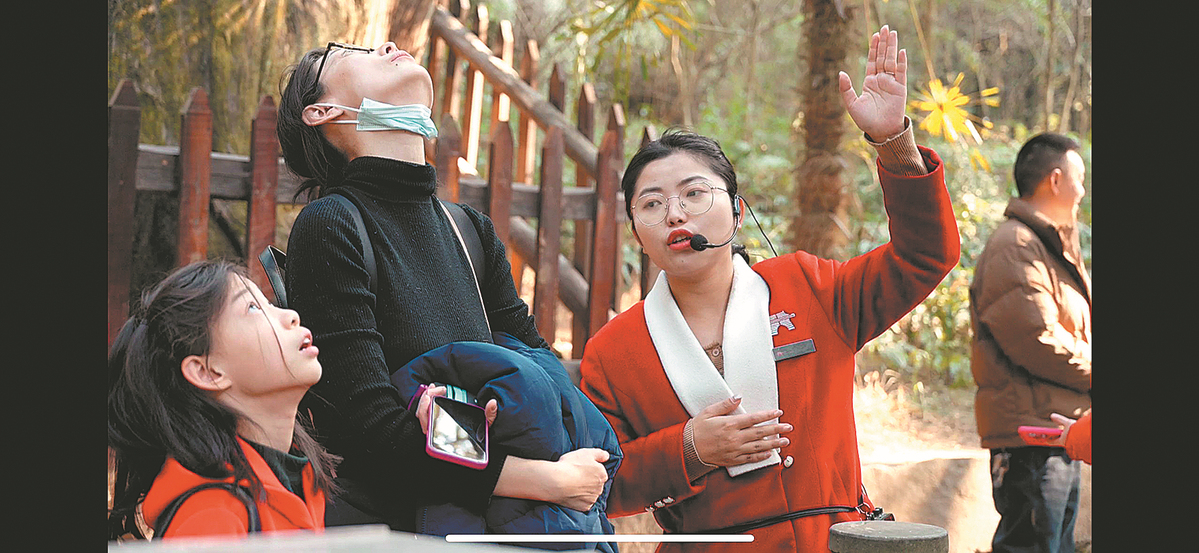
Liang Zhixin, tour guide and interpreter at the Cuiyun Corridor in Jiange county, Guangyuan, Sichuan province
I introduce the Cuiyun Corridor to visitors over a thousand times every year.
Along this path, which renowned strategist Zhuge Liang (181-234), general Zhang Fei (?-221) and Emperor Xuanzong (685-762) of the Tang Dynasty (618-907) once traversed, historical scenes of the exchanges between the "Land of Abundance" in the Tang Dynasty and the outside world have been recorded.
This area has also borne witness to the continuous development of Chinese culture from the Qin Dynasty (221-207 BC) to the present, spanning over 2,000 years.
Every time I weave through these lush millennia-old cypresses, I am deeply drawn in by the serene and profound atmosphere, as well as the traces left by history.
Ancient Sichuan province had a mild climate and abundant resources, but the geographical barrier of the surrounding mountains posed a significant obstacle to external communication. In order to better connect to the outside world, the ancients began to construct the shudao, or the roads to Sichuan. The Cuiyun Corridor is a representative section of this road.
Centered in Jiange county, the Cuiyun Corridor connects the northern part of Sichuan to the outside world and has a total length of 151 kilometers.
During its construction, the ancients planted trees on both sides of the road to clearly mark its position and measure its length. As the trees grew lush, they also provided shade, allowing people to travel even in the hot summers. This created the unique landscape we call "100,000 trees on a 150-km road".
Within Jiange, the Cuiyun Corridor boasts the best-preserved, largest and most numerous ancient tree clusters in China. It is home to 7,803 ancient trees with an average age exceeding 1,000 years.
In the history of the corridor, there were six documented large-scale tree plantings, with particularly massive plantings during the Song Dynasty (960-1279) over 1,000 years ago and the Ming Dynasty (1368-1644) over 600 years ago.
It takes 100 years for these trees to increase their trunk width by just 10 centimeters.
The oldest tree here is over 2,300 years old, and its diameter is longer than the height of an average male human.
One of the oldest trees, known as the Royal Cypress, is 27 meters tall — almost as high as a 10-story building.
Over the course of more than 2,000 years, the Cuiyun Corridor, while serving as a transportation route, has also stood witness to thousands of years of political, military, cultural and economic developments.
Yang Zubin, Party chief of Jiange county, said, "Even if the trees die, they cannot be felled." I believe it is precisely because of the generations of Jiange people's original maintenance that we can still see the most primitive appearance of this cypress forest today.
With technological advancements, the means of protection are becoming increasingly diverse. Now, every ancient tree in the Cuiyun Corridor has its own ID card, recording information such as age and maintenance dates. In addition, over a thousand forest rangers collectively guard this historical treasure.
The corridor has become a nationally renowned 5A-level scenic area, attracting an increasing number of visitors due to its lush mountains, clear waters and profound cultural heritage.
The Cuiyun Corridor, formed by nearly 10,000 ancient cypresses, vividly portrays the interdependence between humanity and nature.
Tens of thousands of visitors come here to adore the treasures, learning not only about history but also how we and the plants have protected and supported each other for thousands of years.
Liang Zhixin spoke to Yan Dongjie.


- Increase in western Pacific military activities noted
- China, Pakistan pledge deeper military ties
- SPP to oversee handling of Shanxi mine explosion case
- Mine blast victims get mental health counseling
- China leads with ‘deep and real’ methane control efforts, expert says
- China calls for fair global ocean governance in Xiamen symposium





