A new phase in cluster development









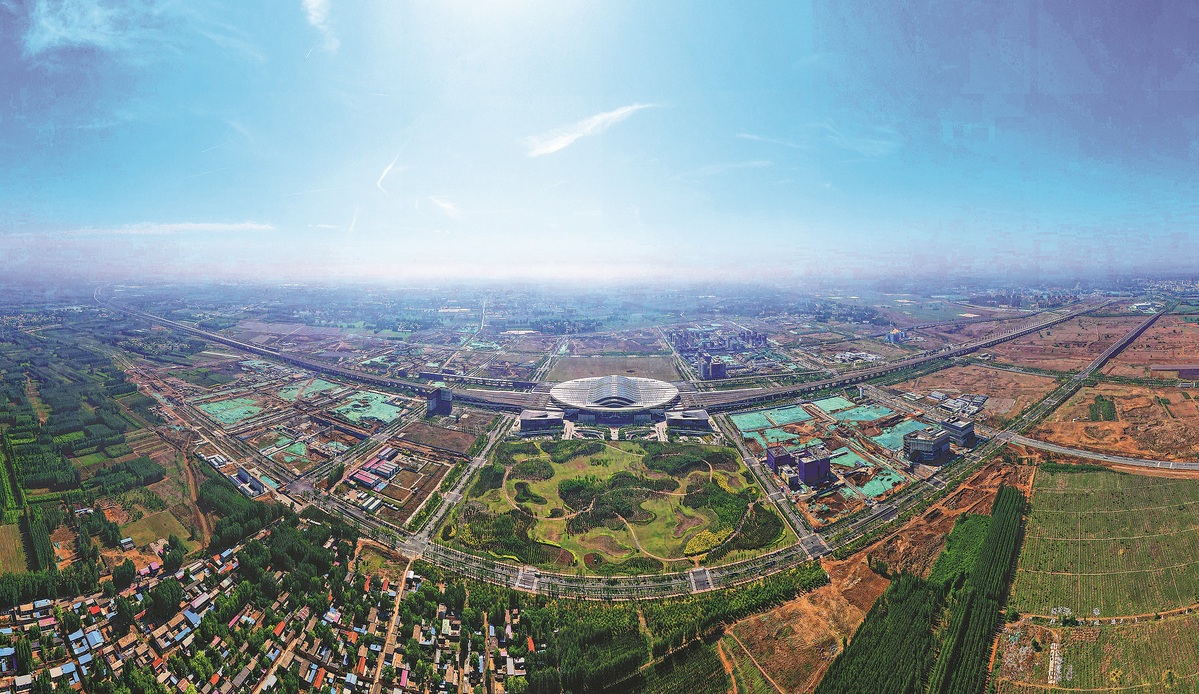
In the 10 years since the implementation of the plan for the coordinated development of the Beijing-Tianjin-Hebei region, significant progress has been made in key areas including relieving Beijing of the functions non-essential to its role as China's capital, building an integrated transportation network and improving coordinated ecological governance. But the Beijing-Tianjin-Hebei region still faces challenges such as insufficient and unbalanced development, sluggish growth, and a continuous decline in Hebei province's economic status.
To address these issues, the plan aims to build a world-class city cluster, based on the "central city-metropolitan area-city cluster" model. The metropolitan area plays the role of a bridge between the central city and the city cluster, making the construction of modern metropolitan areas crucial for promoting coordinated development of the Beijing-Tianjin-Hebei region.
Currently, the Beijing-Tianjin-Hebei region consists of two mega-cities, Beijing and Tianjin. The metropolitan areas around these cities overlap, but the spatial distance between Beijing, Tianjin and the central-southern areas of Hebei exceeds 300 kilometers. This geographical distance prevents Beijing and Tianjin from having a significant radiating effect on the central-southern areas of Hebei.
Therefore, by leveraging the economic power of 3 million residents in the developed area of Shijiazhuang, capital of Hebei province, in 2019, the authorities decided to build the city's modern metropolitan area in an effort to drive the development of the central-southern areas of Hebei and build a world-class city cluster.
The formation and effectiveness of metropolitan areas depend on three factors: the radiating capacity of core cities, the receptivity of areas outside core cities, and the smooth flow of elements between core cities and peripheral areas. Therefore, the construction of the three metropolitan areas in the Beijing-Tianjin-Hebei region should focus on three aspects:
First, efforts should be made to enhance the radiating capacity of core areas of cities. Beijing should leverage its advantages in technology, talents and international exchanges to develop productive service industries and headquarters economy, forming an industrial structure dominated by a modern service economy and building an international consumption center.
Tianjin, on its part, should develop headquarters economy, boost the concentration of productive service functions as the center city of the Beijing-Tianjin-Hebei region, develop advanced manufacturing, promote the transformation and upgrading of advanced manufacturing, and foster the deep integration of the service and manufacturing industries.
And Shijiazhuang should optimize its industrial structure, boost its economic strength, expand its economic scale and gradually fuel the growth of surrounding cities such as Xingtai, Hengshui and Handan.
Second, there is a need to improve the receptivity of areas outside the core areas of cities. Areas outside the cities' core in Beijing, Tianjin and Shijiazhuang should focus on developing key or leading industries, accelerating industrial transformation and upgrading, leveraging the effect of economies of scale, and strengthening the links of the industrial chain with the core areas of cities.
Major cities and the Tianjin metropolitan area, in addition to receiving non-capital functions, should focus on improving the key links of advanced manufacturing, developing industrial clusters with regional characteristics and advantages, building an industrial structure dominated by advanced manufacturing and high-tech industries, and gradually narrowing the industrial development gap with Beijing and Tianjin.
As a surrounding area of Shijiazhuang, Handan should use its existing industrial foundation of steel, coal, building materials and equipment manufacturing to become an important energy, raw material and equipment manufacturing base in the Beijing-Tianjin-Hebei region.
And while Xingtai should utilize its strong foundation of heavy chemical industry to develop new energy vehicles, new energy materials, high-end equipment manufacturing and other industries, Hengshui should exploit its strength as a transportation hub to transform into a strong industrial city and a Beijing-Tianjin technology transformation and industrial transfer base.
Third, measures need to be taken to remove tangible and intangible barriers and smoothen the flow of factors between the core and peripheral areas of cities. And the construction of metropolitan areas should optimize the transportation and communication networks of high-speed railways, expressways, airlines and pipelines, strengthen the connection between different transportation modes and the interconnection of nodal cities, and form a radiation layout of road networks centered on the metropolitan areas of cities.
There is also a need to break the regional divisions and industry monopolies, lift market barriers, abandon regulations and practices that hinder unified market and fair competition, expedite the integration of labor markets, promote the integration of technology markets and financial services, standardize market access norms, and set standard market rules.
By cultivating the metropolitan areas of Beijing, Tianjin and Shijiazhuang, the Beijing-Tianjin-Hebei region can promote high-quality coordinated development.
The views don't necessarily reflect those of China Daily.
The author is a professor at the College of Urban Economics and Public Administration, Capital University of Economics and Business.
If you have a specific expertise, or would like to share your thought about our stories, then send us your writings at opinion@chinadaily.com.cn, and comment@chinadaily.com.cn.