


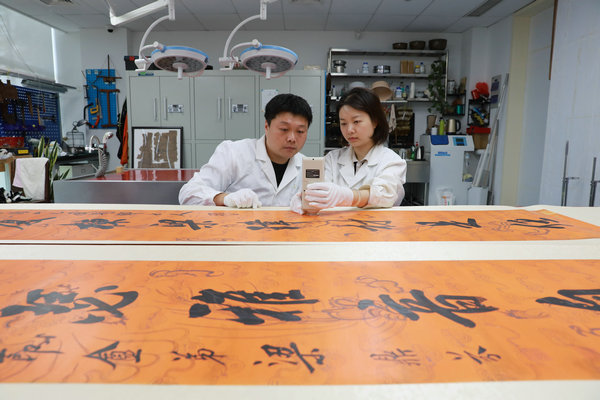
Zhao and Zhang both joined the museum in 2010, but their paths didn't cross until they attended the first pottery restoration training class in Hubei in 2012. It was then that they realized that their skills — Zhao's restoration techniques and Zhang's expertise in relic analysis — complemented each other.
They soon became collaborators at work, and then life partners.
According to Zhao, before restoration begins, relics must be thoroughly examined to identify the causes of damage and establish appropriate repair plans, and he would often invite Zhang into this process.
"Technological assistance aids me in selecting repair materials with greater accuracy," he explained.
Even with modern technology, traditional craftsmanship remains central to relic restoration. As the third generation of restorers since the museum's founding in 1953, Zhao emphasizes the continuity of techniques passed down through generations. "The skills my master taught me were handed down from his master in the 1950s," he said.
While restoration techniques have remained largely unchanged, the materials used have improved over time. Zhao explained that, in the past, restorers relied on potentially harmful substances like potassium permanganate or oxalic acid to eliminate mold from paintings. Nowadays, they employ a low-temperature liquid oxygen flushing method to remove mold. This method may leave some stains, but because it is stable, it not only prevents further mold corrosion but also minimizes the need for aggressive treatments that may damage the original paper.
Throughout his decade-long career, Zhao has restored over 300 pieces and framed over 500 works of calligraphy and paintings.
According to him, in addition to patience and concentration, restoration work may also demand physical strength. For example, some relic pieces can be quite large, requiring restorers to scale heights to access them. "The restoration of each piece typically takes around half a year," Zhao said.





