


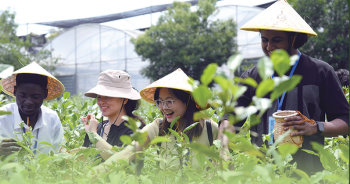
Koffi Paul Arnaud Yao, a 24-year-old pharmacy student from Ivory Coast studying at Changzhou University, noted that both his home country and China cultivate a variety of crops. "In Ivory Coast, we mainly grow export crops such as cocoa and coffee, while China places a high priority on food security, emphasizing crops like rice and wheat," he explained.
In addition to learning about modern agricultural technology, international students also explored a unique aspect of Chinese agricultural civilization: tea culture.
During the trip, they had the opportunity to engage in tea leaf picking and observe the entire tea production process.
Yao was impressed by the art of tea processing. Before this trip, he was unaware of the steps involved in transforming tea from freshly picked leaves to the final product available in stores. "Learning all those steps was truly fascinating to me," he said.
For Raul Sanchez Sanchez, a 20-year-old Spanish student at Nanjing Polytechnic Institute, this hands-on experience greatly deepened his understanding of Chinese tea culture, which he had previously known only through his culture classes. "I realized that you learn more from firsthand experiences than by attending class," he said.
Sanchez was also moved by the locals' dedication and enthusiasm in sharing their tea culture with international visitors. "They conveyed their love and pride for their culture," he said. "I believe that a passionate person can teach better than anyone else."
Of all the steps in the tea production process, fixation, or shaqing — which literally means "to kill green" — stood out as particularly captivating for these young people. During this process, fresh tea leaves are placed in a high-temperature wok and manually stirred to reduce moisture content, halting fermentation, and preserving the tea's essence.
"The temperature in the wok was very high, but the professional used his bare hands, stirring quickly and precisely. It was truly impressive," said Ngo Luu Ngoc Lanh, a 25-year-old Vietnamese student at Jiangsu University.
To Chinese students, who are accustomed to tea being an integral part of their culture, the reactions of international students to tea production seemed to be more intriguing than the process itself. According to Luo Linpeng, 24, a Chinese student at Jiangsu University, he and his Chinese peers frequently asked the international students whether tea was popular in their countries.





