


Beating back the desert
The Three-North Shelterbelt Program serves as a vast barrier against the spread of various sandy lands in northern China. China Daily reporters Yan Dongjie and Cui Jia visited the Tengger, Kubuqi and Badain Jaran deserts to witness the efforts and achievements of the megaproject.










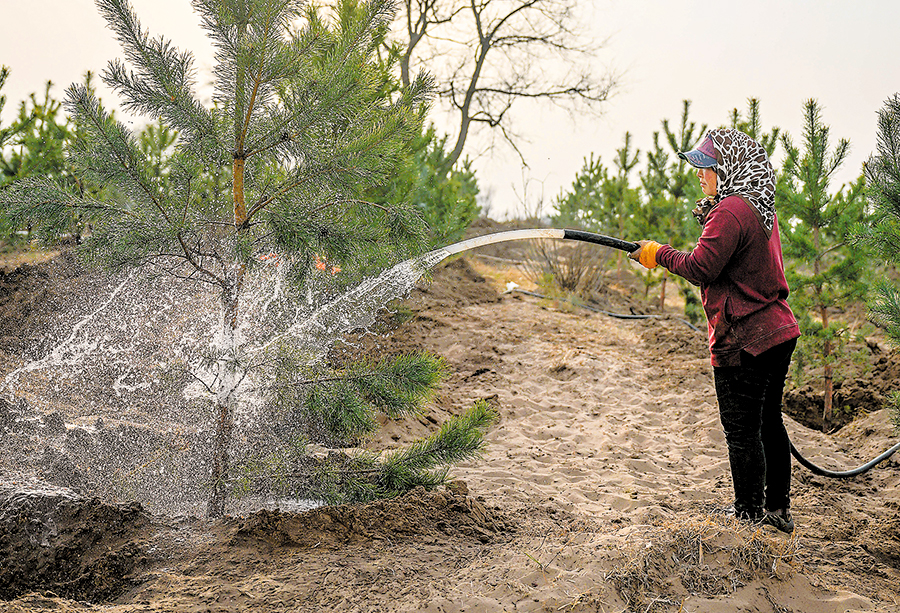
Scientific decision-making
"The key to China's success in its path of sand prevention and control lies in scientific decision-making and planning," said Dang Hongzhong, a researcher at the Chinese Academy of Forestry and the Three-North program research institute, adding that the innovative action taken in Zhangwu county in the 1950s was a step forward in sand control.
In 1952, Zhangwu established China's first sand control research institute, with Liu Bin as its director. Liu and other pioneers in sand control decided to introduce the Mongolian Scots pine from the Greater Hinggan Mountains to control sandy areas.
"In traditional thinking, shrubs or grasses should be used to control shifting sandy areas, and planting trees on shifting sand dunes went against the laws of nature. The old experts were not bound by traditional rules, made bold breakthroughs and embarked on an innovative path that no one had expected," said Dang.
Although they had found a drought-resistant tree species, planting trees on shifting sandy land was challenging.
"Zhangwu was eight latitudes away from the original habitat of the Mongolian Scots pine, making the introduction difficult," said Zhang Xueli, deputy director of the Research Institute of Sand Control and Utilization in Liaoning province.
Liu and other sand control pioneers imported Mongolian Scots pine for three years. In the first year, almost all the saplings perished.
"The experts later found that in their original habitat, the Mongolian Scots pine was covered by thick snow in winter, providing insulation and moisture retention.
"However, Zhangwu is very dry in winter and spring, with strong winds, and only two saplings that were accidentally buried by sand survived," Zhang said.
Learning from that experience, researchers covered the next batch of planted pines with sand and soil. Those pine trees survived the winter, growing into the oldest existing forest in the sandy area, known locally as "the autumn of 1955".
As a result, Zhangwu is also known as the "birthplace of scientific sand control in New China". In 1978, the planting of Mongolian Scots pines in sandy areas won national scientific awards and has since been widely promoted in more than 10 provinces and regions, with Mongolian Scots pines becoming a core tree species in the Three-North Shelter Forests of Hebei, Shaanxi and other provinces.
Over the past 70 years, the forest coverage rate in Zhangwu has increased from less than 3 percent to over 30 percent, and more than 8,500 forestry technicians have spread the experience of afforestation and sand fixation to more than 10 provinces, resulting in more than 1 million hectares of forests being planted.





