


Rescue work key part of low-altitude biz
Leveraging drones to transport critical medical supplies gains ground in nation










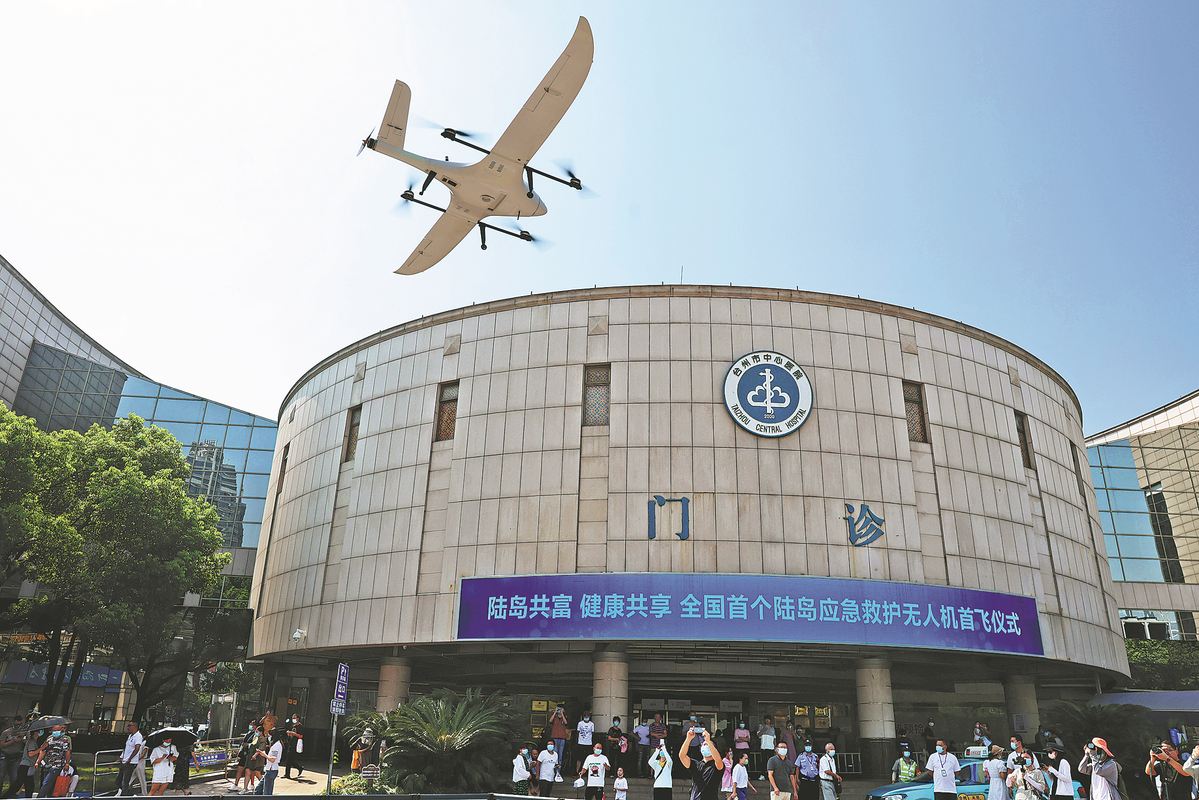
In terms of blood and test samples, drone deliveries greatly reduce delays and improve treatment efficiency. In addition, drones can serve as mobile communication relay platforms, providing temporary air communication capabilities. Especially during circumstances of ground communication facility damages, they can provide critical communication links, Lin said.
"Unmanned aerial vehicles equipped with lighting equipment can provide lighting support for night rescues, help locate trapped individuals and guide rescue teams. Meanwhile, UAVs equipped with a delivery system can accurately deliver rescue supplies — such as water, food and medicine — to designated locations, providing necessary survival support for disaster victims.
"Firefighting drones can carry high-definition cameras and thermal imaging devices to monitor the situation of the fire in real-time, quickly transmit fire data, and improve the response speed and firefighting efficiency of firefighters," he added.
The development of China's low-altitude sector is gathering steam. The low-altitude economy is now viewed as a strategic emerging industry and a new growth engine for the country.
A report by market research firm CCID Consulting, a think tank affiliated with the Ministry of Industry and Information Technology, said China's low-altitude economy was worth nearly 506 billion yuan ($69.8 billion) last year, up 33.8 percent year-on-year, and its value is expected to surpass 1 trillion yuan by 2026.
Speaking of future development trends, Yuan Shuai, executive vice-president of the Rural Revitalization Committee, said that with the continuous maturity and popularization of technology, drones can be applied in more and more emergency rescue scenarios, such as fire rescue, earthquake rescue and other calamities rescue.
"By carrying different equipment and sensors, they can achieve various functions such as aerial reconnaissance, material delivery, and personnel search and rescue. In addition, with the integration of new-generation information technologies such as 5G, the internet of things and big data, a new intelligent rescue system is expected to emerge in the low-altitude economy, further improving the response speed and efficiency of emergency rescue," Yuan said.
Hong Yong, an associate research fellow at the Chinese Academy of International Trade and Economic Cooperation's e-commerce research institute, said that as promising as the future may look, challenges in technology, safety, regulations and other areas cannot be underestimated.
"Drone technology requires continuous innovation and progress to meet complex and ever-changing mission requirements. Specifically, in the field of emergency rescue, efforts are needed to ensure flight safety and prevent accidents. The formulation and improvement of relevant regulations are also essential, so as to ensure the legitimacy and standardization of the application of drones in the field of emergency rescues.
"These challenges require the joint efforts of the government, enterprises and research institutions," he said.
On Jan 4, the Ministry of Emergency Management and the Ministry of Industry and Information Technology jointly issued guidance on the development of emergency-use robots. According to the guidance, efforts are needed to break through key technological barriers of collaborative operation in equipment clusters such as drones and robots, as well as human-machine collaborative operation technology.
Meanwhile, it emphasized the importance of strengthening the innovative application of cloud computing, artificial intelligence, big data, and other technologies in emergency robots to enhance their intelligence level.
Key research areas — including UAV group flight technology, cluster control technology, disaster rapid assessment technology, disaster perception ability rapid deployment technology, pre and post-disaster accurate comparison scanning technology — are highlighted, according to the guidance.
Apart from Chongqing and Pukou district in Nanjing, Zhanjiang in Guangdong province, Shijiazhuang in Hebei province, Hefei in Anhui province and others are also taking related actions one after another.





