



Solid, or liquid, foundation for building a lunar base









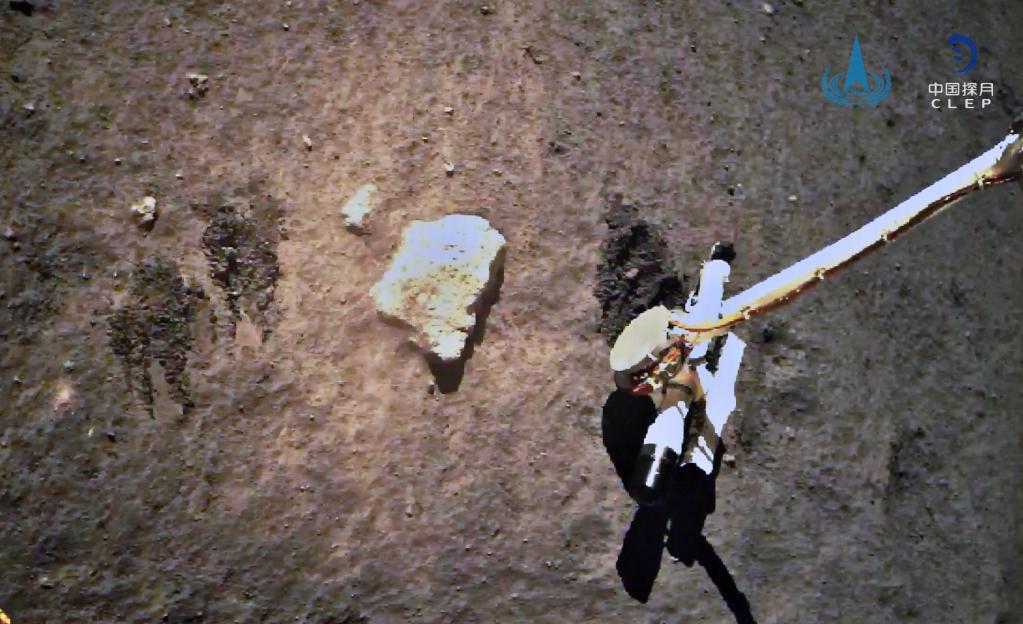
If one were to go by some accounts on social networking sites, one would be inclined to believe what many are sharing with forewords such as "Chinese scientists have discovered large quantities of water on the moon". The real story, as published first as an academic essay in The Innovation, is that domestic researchers have found a high percentage of hydrogen in lunar soil and proposed a new possible way of getting large quantities of water on the moon.
In simpler words, after three years of study and analysis, Chinese research teams have found that a mineral in lunar soil brought back from China's Chang'e-5 mission in 2020 had abundant hydrogen, because solar winds had irradiated the minerals for billions of years. When this hydrogen is heated to high temperatures, it reacts with the iron oxides in the minerals to produce elemental iron and large amounts of water. If heated to temperatures above 1,000 degrees Centigrade, the lunar soil melts and the water generated by the reaction is released as vapor.
Researchers have confirmed that 1 gram of molten lunar material can generate 51 to 76 milligrams of water.
This lays a solid, if not liquid, foundation for building bases on the moon in the future. Mankind needs large amounts of fresh water to survive, but the water discovered in lunar minerals only accounts for 0.0001 to 0.02 percent of the total, making it impossible to be collected on site. Neither is it practical to carry enough water from Earth to the moon.
However, the discovery points at the possibility of finding enough water on the moon to support future lunar bases. According to their calculation, 1 ton of lunar soil can produce about 50 kilograms of water, enough to support 50 people for 24 hours, while the melted lunar soil can be used as bricks for building lunar bases.
The achievement wouldn't have been possible without the overall progress of China's technologies, starting with the Chang'e series of lunar missions bringing back lunar soil samples for research. Space science, material science, chemistry and more sectors such as architecture technology have all been involved, as the participating teams included those from CAS' Ningbo Institute of Materials Technology & Engineering and Institute of Physics, China Academy of Space Technology, Harbin Institute of Technology, Nanjing University and Songshan Lake Materials Laboratory, all glorious institutions in China's technology advance. In some sense, the one after another groundbreaking achievement of Chinese research teams shows not only their sharpening skills but also strengthening collaboration.
— ZHANG ZHOUXIANG, CHINA DAILY





