


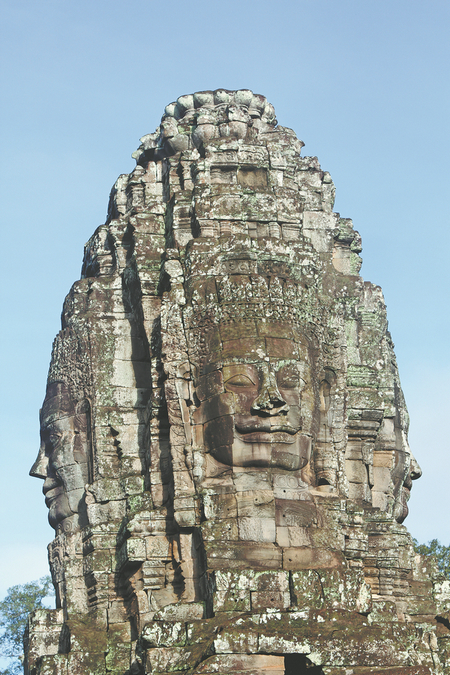
Weather is not the only factor as experts work together to protect relics, Fang Aiqing and Ma Jingna report.
Moss, fungi and lichen may seem inconspicuous but they can damage cultural relics, or, conversely, protect them from erosion. This dual functionality provides a broad selection of research topics and attracts multidisciplinary scholars to continuously explore and innovate effective measures for conservation.
Domestic and foreign academic efforts in this field over the past decade, based on cases conducted under different climates and of different types of cultural relics, were reviewed at the second International Symposium on Biodeterioration and Protection of Cultural Heritage, held at the Dunhuang Academy in Northwest China's Gansu province in June.
Unlike museum collections, kept in a dry and sterile environment, large outdoor artifacts are subject to weathering and undesirable effects from organisms, or biodeterioration, says Gu Ji-Dong, professor at the Guangdong Technion-Israel Institute of Technology in Shantou, Guangdong province.
He cites the Giant Buddha of Leshan in Southwest China's Sichuan province, a UNESCO World Heritage Site, as an example. The 71-meter-tall Buddha statue has long been plagued by mosses, lichens, mold and weeds growing on it. Parts of the Buddha's face, at times, have taken on a black hue as seen in media coverage, despite continuous monitoring and protection.
An internationally acclaimed microbiologist, Gu used to work for Harvard University in the United States and the University of Hong Kong, and now also serves as editor-in-chief of the academic journal, International Biodeterioration and Biodegradation.
Gu explains that in China and many other countries, most cultural relics conservators have an educational background in chemistry or materials science. Upon seeing dark spots on murals, for example, they naturally tend to analyze the chemical substances and reactions, before they realize it's actually the microbes that are causing the color change and damage.
"Preservation measures for large outdoor artifacts ultimately aim to prolong their survival in the natural environment.
"As microbiologists, we want to identify the microbes that are responsible for specific types of damage and how they cause such damage chemically, and by employing intervention measures we can minimize the activities of these microbes as much as possible or prevent their outbreak and attack, so that protection can be achieved by slowing down the damage to allow future generations to appreciate our cultural heritage," he adds.





