


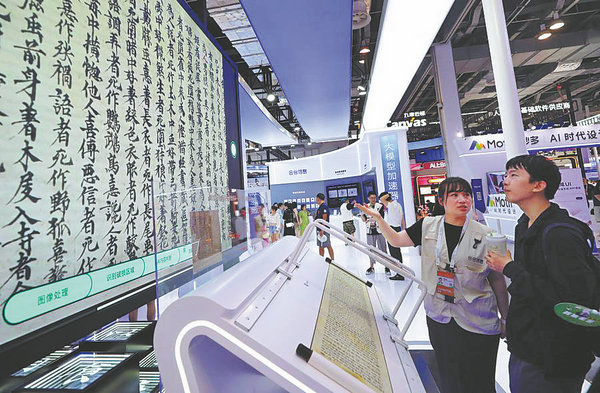
Artificial intelligence is revolutionizing the Chinese film industry, reshaping how movies are made, from conceptual development to post-production.
One striking example of this transformation is a short film by seasoned director Yu Baimei, which reimagines the legendary figure Zhong Kui in a modern context. A heroic figure from Chinese folklore, Zhong Kui is often depicted as a warrior clad in crimson robes, vanquishing evil spirits.
"I've always been drawn to Zhong Kui — humorous, heroic and deeply familiar to us all," says Yu, 49. "Yet, it felt like he's never been portrayed on TV or in movies in a way that truly does him justice."
With the help of AI, Yu created a two-minute short film, Bai Gui Wu Rao ("No Disturbance from Ghosts"), which connects Zhong Kui's legend to contemporary life.
In the film, Zhong Kui strides through a shadowy forest, mist curling between ancient trees under a moonlit sky. Wielding a sword, he confronts otherworldly adversaries, including a monstrous rabbit with glowing red eyes, his movements a symphony of power and grace. The narrative then shifts to a modern bedroom, where a young man snores softly amid flickering phone notifications. The forest battle is revealed to be a dreamscape, with Zhong Kui now embodying the boy's digital "guardian spirit". A playful on-screen message, "On holiday: No disturbance from ghosts", humorously emphasizes the need for personal time in the digital age.
This experimental film, alongside AI-generated shorts from eight other acclaimed directors, debuted in December as part of the "Kling AI Director Co-Creation Project" at the China National Film Museum. These works have been inducted into the museum's permanent collection, marking a groundbreaking moment for Chinese cinema.
Yu's foray into AI filmmaking reflects a broader trend of AI's expansion within the industry.
"AI now permeates every aspect of filmmaking, from conceptual development to post-production," says Rao Shuguang, president of the China Film Critics Association.
Celebrated director Zhang Yimou's ongoing adaptation of The Three-Body Problem, the Hugo Award-winning sci-fi novel, exemplifies this trend.
"Beyond refining the script, the first thing I did was establish an AI team," Zhang explains. "Using new technologies and concepts in the production process is a learning experience for me."
Major studios are also leveraging AI to push creative boundaries. Bona Film Group's AI-powered micro-series on the Sanxingdui archaeological site allegedly blends sci-fi storytelling with industrial-grade filmmaking.
Meanwhile, Yangshipin, a video platform under China Media Group, released Chinese Mythology, a fully AI-produced micro-series utilizing text-to-image, text-to-video, text-to-music and text-to-voice workflows.
While AI enhances efficiency in areas like visual effects, storyboarding and set design, its role as a creative partner, rather than a replacement for human artistry, remains a point of debate.
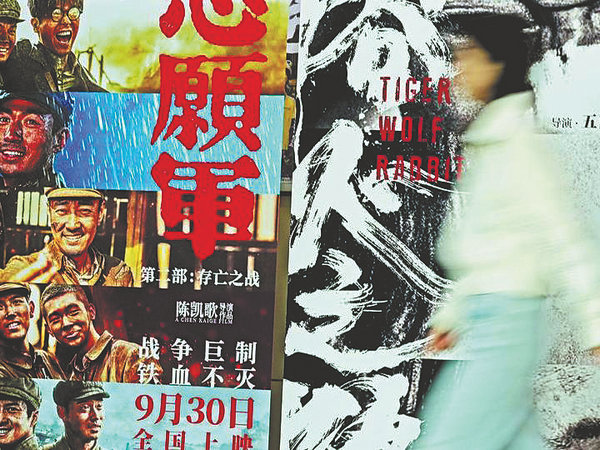
French filmmaker Luc Besson, speaking at the 2024 Hainan Island International Film Festival, described AI as a "valuable tool" but noted its limitations. While AI might draft a sequel to Dogman, he said, it could never create something as original as the 2023 action-thriller hit itself or the 1988 romance film The Big Blue, because AI relies on existing material.
Chinese filmmakers share this nuanced view.
"Human imagination, creativity and innovation remain irreplaceable by AI," Rao says.
Still, he emphasizes the urgency for filmmakers to swiftly and comprehensively learn and adopt evolving AI technologies, as failure to do so could result in being outpaced by more skilled peers.
China's AI filmmaking revolution parallels developments in Hollywood. In 2024, Lionsgate entered into a partnership with AI startup Runway to develop a generative model trained on its extensive film and TV library. Similarly, director James Cameron joined the board of Stability AI, signaling growing interest in AI's creative potential.
Chen Xuguang, director of the Institute of Film, Television and Theatre, Peking University, envisions a future where filmmaking transitions from a resource-heavy industry to a lightweight, AI-enhanced model.
"With the power of AI, a small team — or even an individual — can evolve into a highly efficient and creative production workflow, forming a robust industrial chain," Chen says.
The adoption of AI extends far beyond filmmaking. According to a 2024 report by the China Internet Network Information Center, 230 million Chinese — 16.4 percent of the population — were using generative AI-powered products by June 2024.
"Sooner or later, AI will fully integrate into every aspect of our lives, becoming a friend to everyone," says Yu. "The nine directors in this initiative, regardless of the quality of their final works, have set a valuable precedent. Not that filmmaking in the future should be left to directors alone — but that anyone can create."





