



Huge potential is there in market, but how to tap it?









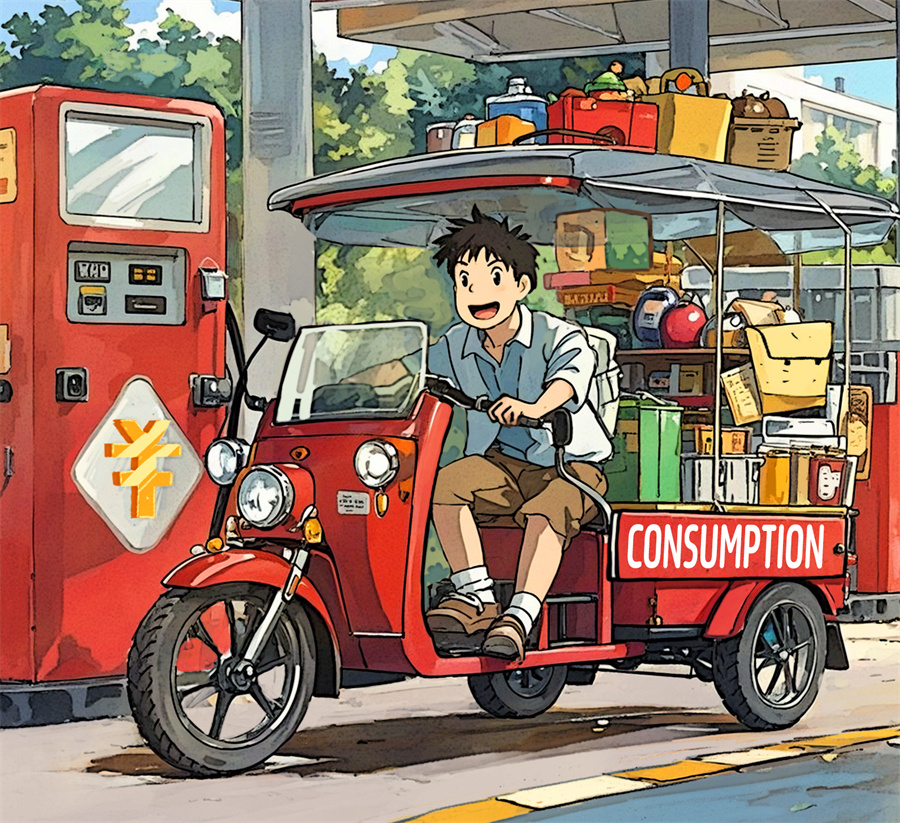
The Central Economic Work Conference has made expanding domestic demand a top priority, marking it as the first of nine key economic tasks for 2025. At the forefront of this effort is a strong emphasis on reviving consumption, a critical factor for both short-term economic stabilization and long-term structural transformation.
However, concerns about a perceived shift from "consumption upgrade" to "consumption downgrade" seem to have arisen, fueling anxieties about China's consumption growth trajectory.
A more detailed analysis from a micro perspective reveals that while these concerns are understandable, they do not capture the full picture. China's consumer market holds immense potential, and aligning with micro-level changes in consumer behavior is essential to better unlock macro-level potential of consumption growth.
Internal satisfaction prioritized
From a macro perspective, China's consumption patterns show some similarities with Japan, considering the dual pressures from an aging population and real estate market adjustments. However, China's microlevel consumer behavior is far more diverse.
For instance, significant differences in consumption preferences exist between the eastern and western regions of China. Meanwhile, advances in artificial intelligence and internet technologies are gradually bridging these gaps, creating a more interconnected market.
Our recent survey reveals that Chinese consumer preferences have undergone significant changes, influenced by the pandemic and cultural trends worldwide.
Chinese consumers are paying more attention to shopping for themselves rather than showing off purchases to others — shifting from pursuing "external display "to "internal enjoyment". Spending patterns indicate a decline in going out for entertainment but rising spending on health and self-improvement, alongside more selective expenditures on food and beverages.
The survey also found that consumers prefer personalized, quality products that can provide personal satisfaction. By contrast, appearance, durability, social recognition and brand cachet are less valued. Customized products that reflect individuality are increasingly preferred over standardized or mass-market offerings.
Consumers now prioritize products with the best value for money — the biggest bang for the buck — rather than simply seeking discounts or choosing high-priced products, showing a pragmatic pursuit of cost-effectiveness. The balance between personal satisfaction and practicality is becoming a driving force behind purchasing decisions.
The directional revolution in consumer preferences is not merely a response to generational and societal changes, but also a structural shift tied to China's transition from a low to a middle-income economy.
From an economic perspective, the ultimate purpose of consumption is to maximize utility. Whether this utility is reflected in a higher price or a more practical and pragmatic choice cannot simply be categorized as an "upgrade" or "downgrade".
What matters more is understanding the psychological and behavioral changes in consumer preferences as well as the new macro trends that such shifts signify.
Role of fiscal spending
Fiscal spending plays a pivotal role in unlocking the potential of services consumption. While fiscal spending is more frequently linked with investment, we have undertaken empirical research to figure out the relationship between fiscal deficits and consumption in emerging markets, including China, India, Brazil, Indonesia, South Africa and Mexico.
The results show that fiscal deficits can significantly boost household consumption over the long term. When other conditions remain unchanged, a 1 percentage point increase in the fiscal deficit ratio is associated with a 0.21 percentage point rise in household consumption.
The finding underscores the importance of fiscal policy, not only in driving short-term investment, but also in stimulating consumption growth over the long run.
As the central government considers raising the fiscal deficit ratio in 2025, both consumption and investment — the twin engines of domestic demand — are expected to benefit over both the short and long term.
It is worth noting that fiscal spending can generate a multiplier effect, which measures the impact of government spending on economic output. For example, a multiplier of 1 means that each $1 of government spending generates $1 in GDP growth.
In China, empirical studies suggest that the short-term fiscal multiplier is around 1, while its long-term value is close to 2, highlighting the significant leverage of public spending in boosting economic growth and consumption.
Additionally, fiscal spending can lead to crowding-in consumption, which means that increased government spending attracts more private spending leading to improved market confidence and new economic opportunities.
Empirical studies show that the transmission from government spending to household consumption takes time to reach its peak effect. Initially, fiscal spending subsidizes households and private enterprises, gradually boosts expectations and confidence, and then shows its impact on consumption. This crowding-in effect intensifies over time, requiring patience during the early stages.
In short, China's consumption story is one of transformation rather than decline.
The shift from "external display" to "internal enjoyment" in terms of consumer preferences provides opportunities for policymakers to align macroeconomic initiatives with micro-level consumption trends.
The specific policy focus should center around boosting consumption of both goods and services, in addition to the substantial multiplier and crowding-in effects expected to be brought by additional fiscal deficit.
The writer is chief economist at ICBC International Holdings Ltd, a wholly owned subsidiary of Industrial and Commercial Bank of China in Hong Kong. The article is based on his speech at a recent event held by the China Macroeconomy Forum.
The views do not necessarily reflect those of China Daily.











