



Rare earth deposit found in Yunnan
Million-ton discovery thought to be largest of its kind in the country









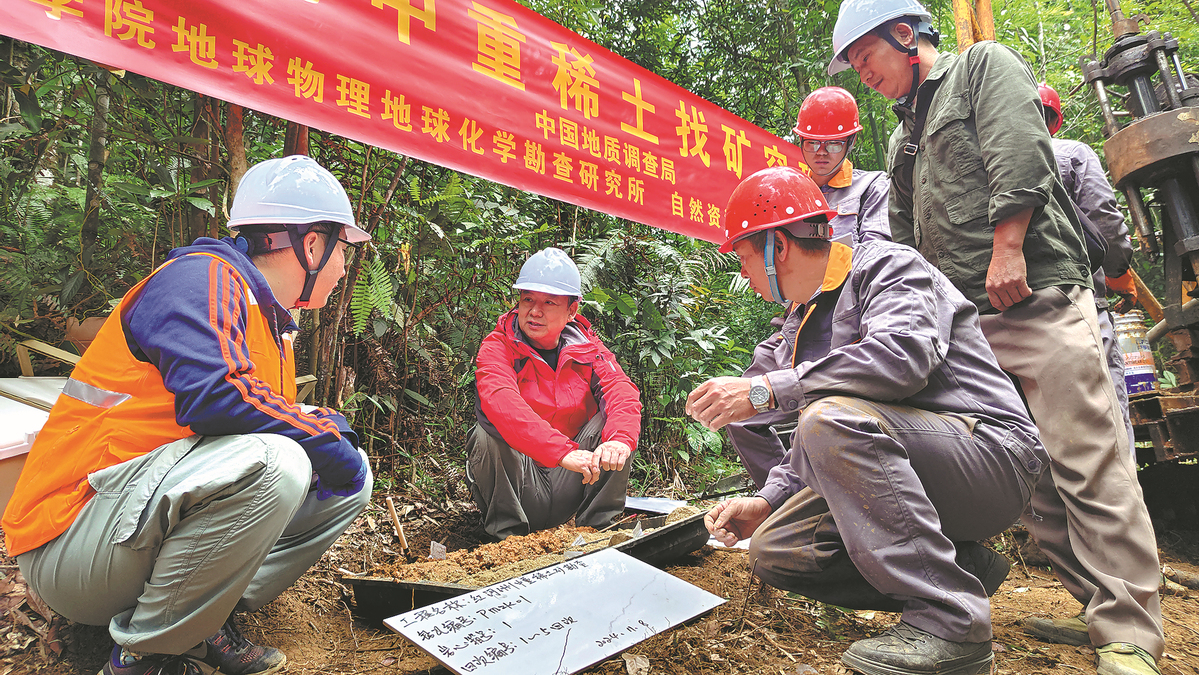
China has discovered a rare earth deposit in Honghe, Yunnan province, composed of about 1.15 million metric tons of potential resources, further consolidating the country's rare earth resource advantage and industrial chain, the China Geological Survey said Friday.
The deposit includes more than 470,000 tons of critical rare earth elements, including praseodymium, neodymium, dysprosium and terbium, according to the CGS, a division of the Ministry of Natural Resources.
Primarily consisting of medium and heavy rare earths, the deposit is thought to be the largest of its kind in China. Medium and heavy rare earths are relatively scarce in the country but are crucial elements in electric vehicles, renewable energy, national defense and high-tech industries, the CGS said.
"Each new energy vehicle requires about 0.8 of a kilogram of medium and heavy rare earths, leading to substantial and increasing demand each year," said Hou Zengqian, an academician with the Chinese Academy of Sciences.
The discovery marks another major breakthrough for China since the first super-large ion-adsorption rare earth deposit was found in Jiangxi province in 1969, the CGS noted.
Hou said exploring medium and heavy ion-adsorption rare earth deposits is challenging due to their relatively low overall content and lack of distinctive mineral forms easily identified in the field.
Unlike deposits of iron or leadzinc ore, which can be quickly delineated with magnetic or electrical methods, rare earth deposits rely heavily on precise field measurements and laboratory analyses, Hou added.
The breakthrough was achieved by scientists who identified enrichment patterns for medium and heavy rare earths through geochemical mapping and scaled-up exploration efforts, Hou said.
Over the past decade, the CGS has built a national geochemical baseline network, gathered extensive geochemical data and developed a fast, precise and eco-friendly exploration system for ion-adsorption rare earths, the agency said.
"Our exploration methods are green, causing nearly zero surface damage," said Wang Xueqiu, chief scientist at the Institute of Geophysical and Geochemical Exploration at the CGS.
Wang and his team collected stream sediments in natural areas such as rivers and terraces. They also used a Gannan drill, a manual tool that requires no infrastructure and creates small holes about 10 centimeters in diameter, avoiding harm to vegetation, Wang said.
Extracting ion-adsorption rare earths involves drilling holes in a small hill, injecting extractants and collecting the rare earth elements — all without disturbing existing vegetation, he added.
Hou said scientists will continue to focus on advancing technologies for efficient separation and high-value usage of rare earths to strengthen the industry chain and boost international competitiveness.


- Tianjin University student carries China-Pakistan friendship into climate research
- Cranes and elephants unite as Yancheng hosts Nairobi photo exhibit
- Long March film Crossing set to boost Guizhou tourism this summer
- Rainy season brings Guizhou waterfall to thunderous splendor
- Diplomats, experts highlight role of skills training ahead of WorldSkills event
- Top court reiterates zero tolerance for child abuse





