



Trump's tariff moves designed to serve economic, political objectives









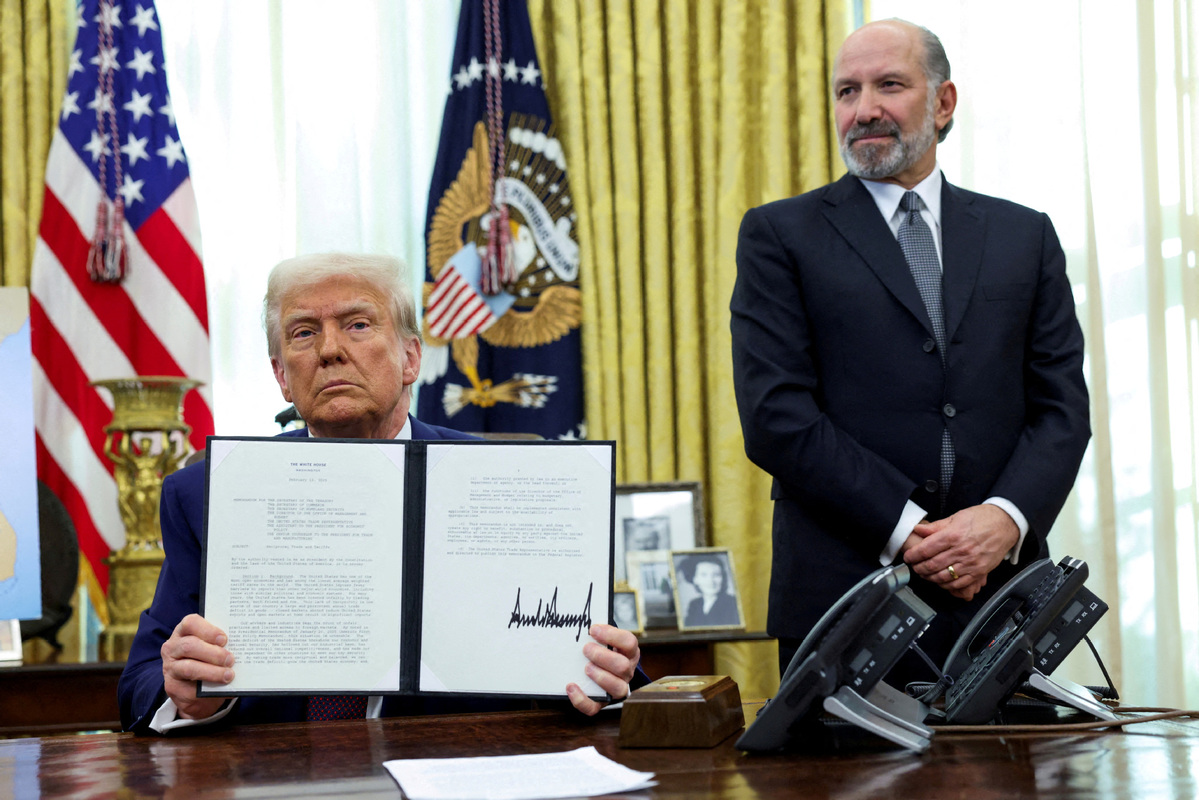
United States President Donald Trump, who entered the White House for a second term, described tariff as "the most beautiful word in the dictionary" several times during his campaign.
In his opinion, tariffs are a multipurpose weapon for achieving three objectives: compelling foreign leaders to negotiate, rebuilding the US manufacturing sector, and reducing the US trade deficit.
The first objective was clear in his Feb 1 announcement of 25 percent tariff on all imports from Canada and Mexico, and an additional 10 percent tariff on all imports from China, which took effect on Feb 4.
Trump waited until the last minute to cut a deal on Feb 3 with Canadian Prime Minister Justin Trudeau and Mexican President Claudia Sheinbaum, pausing the imposition of tariffs for 30 days. Canada and Mexico, which had prepared precise lists of retaliatory tariffs in the event the US duties took effect, did the same.
Canada and Mexico also committed thousands of soldiers and police personnel on their respective borders to curb the flow of immigrants and fentanyl — Trump's immediate objectives, which are far removed from traditional trade concerns.
Before the tariff pause was announced, the US and world stock markets tumbled. That was important because Trump gauges his success with three metrics: the stock market, the headlines and the opinion polls. The initial stock market reaction was unwelcome. However, once the pause was announced, the markets recovered, and headlines proclaimed a Trump victory.
Nationalistic sentiment has reached peak levels among people in the US, fanned by Trump's grievances against foreign countries. It will take time for opinion polls to report on public approval or disapproval of Trump's tariff policies, but until those policies translate into higher prices and lost employment, attitudes are likely to stay positive.
Meanwhile, the Trump administration's additional 10 percent tariff on all imports from China took effect on Feb 4, taking the total US tariff on such imports to above 30 percent. China predictably took countermeasures, but not one-for-one.
Trump declared that the new 10 percent tariff on China was just "an opening salvo", adding that "If we can't make a deal with China, then the tariffs would be very, very substantial".
He has also threatened to impose tariffs on Europe, and named several global products destined for tariffs, including steel, aluminum, pharmaceuticals and semiconductors, among others.
His tariff assaults on allies and adversaries alike are unlikely to spark a US manufacturing renaissance, nor will they make a serious dent in the US global trade deficit, which is around $900 billion annually. But the assaults do have several adverse consequences.
If all the threats evolve into actual tariffs, inflation in the US will surge. New tariffs averaging 20 percent on imports from the world could raise the consumer price index and personal consumption expenditures index by almost 2 percentage points, in other words, escalating inflation to above 4 percent, when direct and indirect effects are fully counted.
The Federal Reserve would need to raise its policy rate above 4.5 percent, sparking a rise in mortgage interest rates above 8 percent. That will be painful for any young couple buying their first home and for everyone rebuilding after damage from hurricanes and wildfires.
High interest rates also will take a toll on the stock market, while retaliation from countries hit by new US tariffs will destroy jobs in the targeted US industries.
Such economic consequences cannot be favorable for Trump when US midterm elections are due in November 2026. Surveying the outlook, Trump could declare victory on his tariff threats and pull back on actual implementation.
For multinational corporations doing business around the world, "uncertainty" becomes the watchword. US commitments to the World Trade Organization, free trade agreements, and other pacts no longer provide a solid foundation for long-term investment.
Other global economic powers, such as China, the European Union and Japan, will very likely respect their own commitments, but multinational corporations will carefully assess the extent of disruption before making new investments.
If chaotic policies patterned after Trump spread, not only trade but also finance and digital connections will be interrupted. The world economic order created during World War II will no longer exist. It may be replaced by something akin to the commercial and financial disorder between World War I and World War II.
On an optimistic note, other countries may design their international policies around the US. They may strengthen their own bilateral and multilateral relations, through trade arrangements such as the Comprehensive and Progressive Agreement for Trans-Pacific Partnership, the Regional Comprehensive Economic Partnership, the EU-Mercosur agreement and other pacts.
They may create alternatives to the dollar-centered financial system. Multilateral financial institutions, such as the World Bank, the International Monetary Fund and the Asian Infrastructure Investment Bank, may gain fresh support from new members. All said, the world could be pleasantly surprised by constructive reactions to Trump's destructive policies.
The author is a senior fellow at the Peterson Institute for International Economics, an independent nonprofit, nonpartisan research organization in Washington, DC, the United States.










