


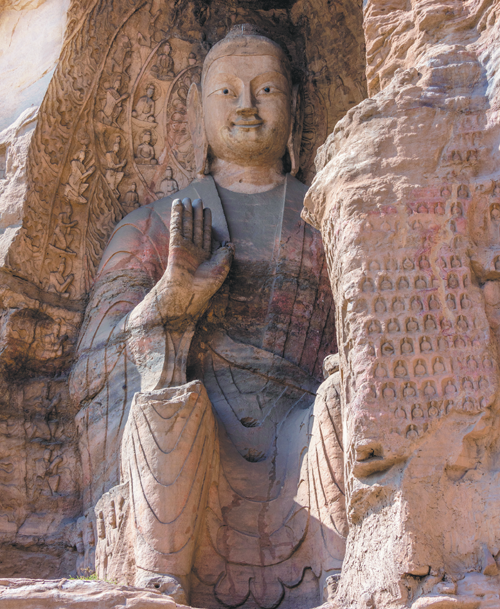
 The Yungang Grottoes, a UNESCO World Heritage Site in Datong, Shanxi province. CHINA DAILY
Editor's note: China Daily reporters leverage local expertise in crafting diverse itineraries to showcase a blend of historical landmarks and natural wonders across highly recommended cities and sites, offering practical guidance to experience the country.
Nestled in the heart of North China, Shanxi province is a treasure trove of natural and cultural wonders. The magnificent Yellow River meanders along its western and southern borders for nearly 1,000 kilometers, while the imposing Taihang Mountains stand guard to the east.
Shanxi is located on the eastern edge of the Loess Plateau, and its mosaic of mountains and deep valleys have created a diverse, rugged terrain. Historically, the region was a crossroads between agrarian and nomadic civilizations. Its proximity to various ancient capital cities has endowed it with a rich cultural heritage, as exemplified in its abundance of ancient architecture.
According to Shanxi's cultural heritage administration, the province is home to more than 28,000 ancient buildings. Remarkably, more than 80 percent of China's surviving timber-framed structures from the Yuan Dynasty (1271-1368) and earlier are found in Shanxi.
This cornucopia of temples, monasteries, pavilions, dwellings, pagodas and bridges — together with the exquisitely painted sculptures and murals that many of them are known for — reflects the political, economic, cultural and religious influences of different historical periods, and conveys the intellectual legacies of Confucianism, Buddhism, Taoism and local folk beliefs.
Lu Yi, director of the Shanxi Academy of Ancient Building, Painted Sculpture and Fresco Preservation, explains that the historical abundance of forests in the province provided the quality materials essential for timber-framed structures. The loess soil was fundamental to the construction of rammed earth structures, and plentiful coal deposits enabled the mass firing of bricks and tiles, as well as the colored glaze, or liuli, which adorns many prestigious ancient buildings.
Moreover, Shanxi's dry climate and rarity of floods and earthquakes have contributed to the longevity of its heritage. Historically, it experienced relatively few political or military upheavals, and its strong tradition of sacrifice inspired generations to invest time and resources into protecting time-honored structures.
All these natural and historical factors enable Shanxi to preserve a wide range of structures built during the Northern Wei (386-534) and Northern Qi (550-577) dynasties, as well as from the Tang (618-907) to Qing (1644-1911) dynasties, Lu adds.
According to Lu, the ancient buildings dotting this rhombus-shaped province exhibit distinct regional characteristics.
In northern Shanxi, as represented by Datong and Shuozhou, there are many large-scale Buddhist structures. The provincial capital Taiyuan and its surrounding areas have numerous buildings dedicated to various beliefs. To the south, historical structures are more associated with the sacrificial traditions of agrarian culture, while southeastern Shanxi has many buildings related to deities from ancient legends.
Since August, China's first AAA video game, Black Myth: Wukong, has captivated millions of players who have taken on the role of the Destined One and embarked on a virtual adventure based on the 16th-century novel Journey to the West. Offline, a soaring number of visitors are flocking to Shanxi on pilgrimages, as 27 of the 36 scenes in the game are inspired by the province's ancient architectural marvels.
These notable sites include the Yungang Grottoes in Datong, a UNESCO World Heritage Site, and the Sakyamuni Pagoda at Fogong Temple in Yingxian county, a nearly 1,000-year-old wooden pagoda believed to be one of the tallest and oldest of its kind in the world.
Last year, the province saw a 27.24 percent year-on-year increase in domestic tourist visits, with total expenditure rising by 36.03 percent. This surge continued over the Spring Festival holiday, according to preliminary statistics by the culture and tourism authorities.
Feng Ji, founder and CEO of Game Science, which developed the blockbuster game, said in an interview with State broadcaster China Central Television in September that to accurately re-create ancient buildings and artifacts in the game, the production team spent four years scanning hundreds of temples and historical sites across the country and replicating them.
"We've proved that by combining traditional Chinese culture with cutting-edge technology, visuals and music, and supplementing it with reasonable gameplay, a chemical reaction will occur," he says.
Following the footsteps of the Destined One, China Daily is taking a journey to some of the most-visited architectural heritage sites in Shanxi to explore the enduring stories they have told across millennia.
Contact the writers at fangaiqing@chinadaily.com.cn





