



A benign competition measured in qubits









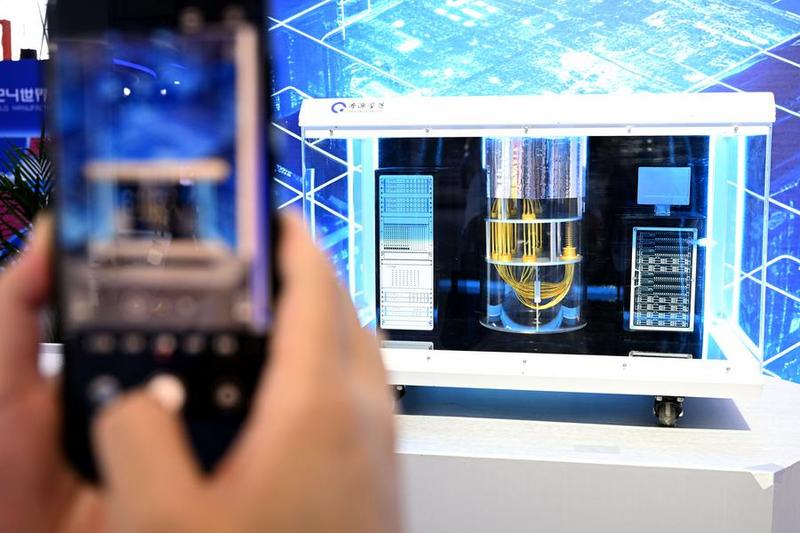
Zuchongzhi 3.0, or the latest superconducting quantum computer model developed by Chinese scientists, has set a new benchmark for quantum computational advantage.
In 2012, John Preskill, a theoretical physicist at California Institute of Technology, coined the concept of quantum computational advantage, or quantum supremacy, to describe the point where a quantum computer can perform a task that a classical computer cannot realistically accomplish within a reasonable time frame.
Quantum computing's advent marks a paradigm shift from conventional computing in that quantum computers deploy quantum bits (qubits) to store quantum information in values between 0 and 1 while conventional computers process information in the form of digital bits (0s and 1s).
This means the values that quantum computers can make use of far exceed conventional ones. That's why a key index of a quantum computer is the number of qubits it uses — in 2019, Google was the first to claim quantum supremacy with a 53-qubit Sycamore processor completing in 200 seconds a random circuit sampling task, which the fastest supercomputer at the time would have taken approximately 10,000 years to simulate.
To unify standards, a consensus emerged to use the optimal classical algorithm as the benchmark, following which the world's first strictly proven quantum computational supremacy was achieved in 2020 by a research team from the University of Science and Technology of China on the Jiuzhang photonic quantum computing prototype, while the first strictly proven quantum computational supremacy in a superconducting system was achieved by the same team using the Zuchongzhi 2.0 in 2021.
In October 2024, Google's Sycamore, which had a 67-qubit superconducting quantum processor, achieved quantum supremacy surpassing classical supercomputers by nine orders of magnitude, or becoming billion times faster. That tells you how big a step forward Zuchongzhi 3.0 marks with 105 qubits. To quote an academic essay of the team, "Our experiments with an 83-qubit, 32-cycle random circuit sampling on Zuchongzhi 3.0 highlight its superior performance, achieving 1 million samples in just a few hundred seconds."
Many global observers have said that the 105-qubit processor is a competitor to Google's Sycamore. However, such competition is benign because it will benefit whole mankind. China holds an open attitude toward such competition and looks forward to research teams from the United States and elsewhere making greater breakthroughs.





