



Stronger Sino-Turkish ties to mutual benefit









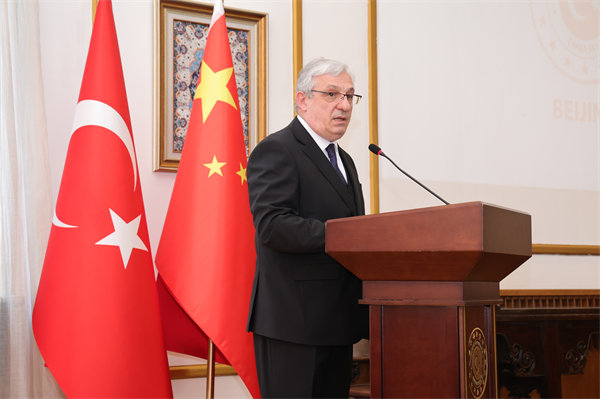
China and Turkiye are key geopolitical players and advocates of a multipolar world, but the growth in bilateral trade has been driven by market forces rather than government-led initiatives.
Turkiye primarily imports semi-finished goods and raw materials from China, which it then processes and re-exports to other countries, indicating Turkiye's limited access to alternative suppliers. The country's principal exports to China include natural stones and minerals. But the relatively small scale of Turkish enterprises, along with the geographical distance between the two countries, hinders Turkish enterprises from establishing a prominent presence in China's market.
Market dynamics favor larger economic players, exacerbating the trade imbalance between the two countries. In 2023, for example, the trade volume between the two countries reached $43.4 billion, yet the disparity remains stark: China accounts for 93 percent of the total, with Turkiye accounting for a meager 7 percent. Notably, Turkish products have yet to gain significant market recognition among China's affluent population.
Addressing this imbalance requires a comprehensive approach to managing economic relations. A closer look at Chinese investments in Turkiye, a key factor in correcting the trade gap, shows a worrying trend. China has substantially increased its investments in the Belt and Road countries, yet Turkiye's share remains minimal despite the country's official participation in the Belt and Road Initiative since 2014.
However, Chinese direct investment in Turkiye remains relatively small, largely due to the perception in the Chinese government of Ankara's inconsistency. The trade imbalance has led to the imposition of non-tariff barriers against Chinese goods, adding further uncertainty to bilateral relations.
Turkiye's economy is the largest and its military the most powerful in the Middle East. But despite Turkiye's economic policy and banking system being based on Western models, it remains dependent on Eurasian countries for energy security and industrial intermediate goods.
According to the Turkish Ministry of Trade, in 2024, China and Russia were the largest and second-largest exporters to Turkiye, with Russia and China being the biggest and second-biggest trade partners respectively for Turkiye. The two countries accounted for $100 billion of Turkiye's total trade volume of about $606 billion. In fact, Turkiye conducts one-sixth of its foreign trade with these two countries. As for Turkiye's primary export destinations, they include Germany, the United States, the United Kingdom, the United Arab Emirates, Iraq, Italy and France. Turkiye's presence in these markets provides a strategic advantage for China.
What further augments Turkiye's economic significance is its geographical location at the confluence of Asia, Europe and Africa, bordered by seas on three sides.
By formally joining the Belt and Road Initiative in 2014, Turkiye aimed to extend its influence to the railway link between Asia and Europe. Turkiye joined hands with Iraq and Qatar to launch the "Development Road" project, in order to emphasize its "vital role" as an economic bridge between West Asia and Europe.
On the other hand, China's geographical distance from Europe and West Asia and its reliance on maritime routes pose a risk to its foreign trade, as do Western restrictions on China's high-tech sector. Hence, China could leverage Turkiye as a production and distribution hub to overcome these challenges.
As a member of the EU Customs Union since 1996, even without full European Union membership, Turkiye offers a key advantage: Chinese products manufactured in Turkiye can enter the EU's markets with zero customs duty. Products manufactured in Turkiye can evade EU and US restrictions, enabling their smooth delivery to Europe and the Middle East, including North Africa, from Turkiye's free zones.
Significantly, there is no market conflict or political rivalry between China and Turkiye. Both countries are striving to help build an egalitarian, rules-based multipolar world. And deeper economic cooperation based on mutual benefit would allow Turkiye to take a firmer stance against the West, which has been putting increasing pressure on China on the economic and other fronts.
Turkiye's role in fostering a multipolar world, exemplified by its potential BRICS membership, is critical. China's recognition of Turkiye's strategic importance and bold initiatives could significantly advance mutual interest and global well-being.
The author is chairman of the Turkish-Chinese Business Development and Friendship Association.
The views don't necessarily reflect those of China Daily.
If you have a specific expertise, or would like to share your thought about our stories, then send us your writings at opinion@chinadaily.com.cn, and comment@chinadaily.com.cn.





