



Tech used to help hold back desert









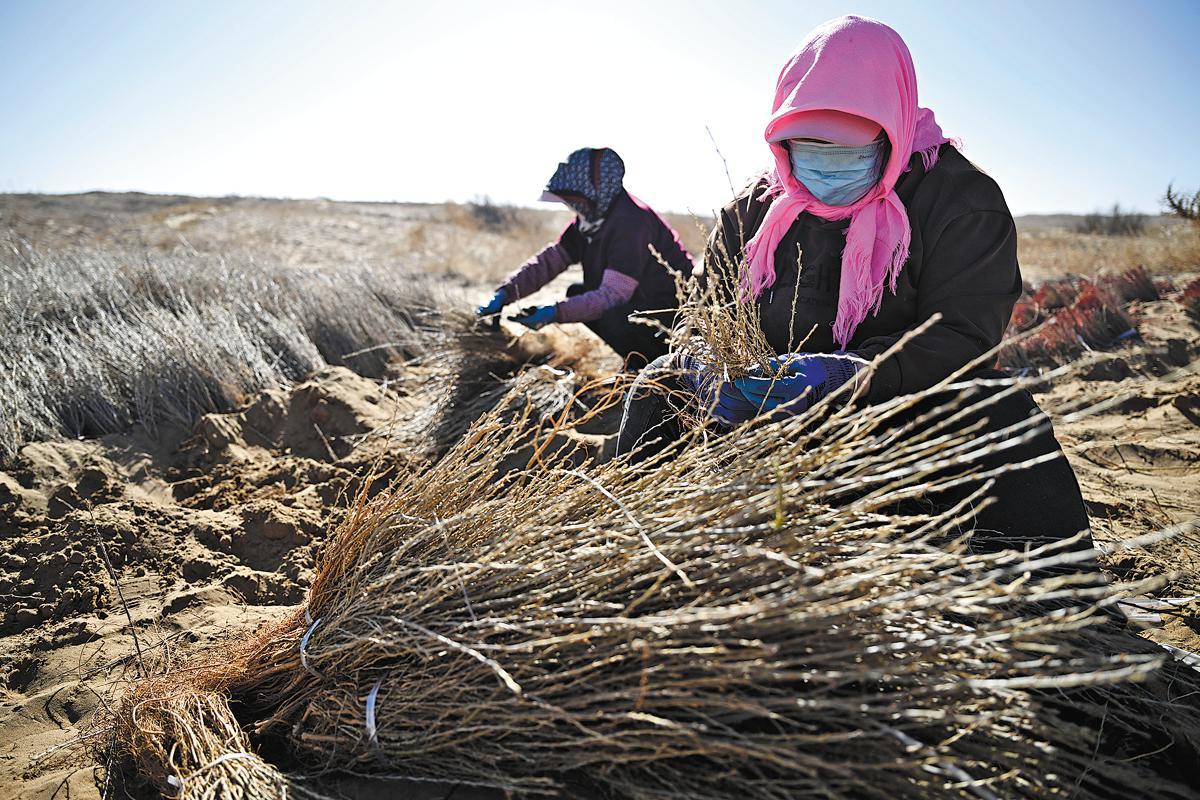
HOHHOT — The challenging task of afforestation at the edge of the Mu Us Desert in northern China has taken on a futuristic feel this spring, with drones soaring through the air, transporting seedlings across vast sand dunes, while intelligent planting machines carve troughs planting saplings with precision.
"It only takes five seconds for these robots to plant a seedling in the desert," said Gao Fei, as he remotely operated two planting machines.
Gao, who works at Jintaiming Technology Group based in northern China's Inner Mongolia autonomous region, explained that these are the company's second-generation intelligent tree-planting machines. They can completely automate the tree-planting process, from loosening the soil with an auger and inserting the sapling to watering its roots, covering it with soil and compacting it.
"Four such machines, still in the trial phase, were deployed this year. The production line for the machines has yet to be fully launched," Gao said, adding that the company holds intellectual property rights for the machines.
He went on to explain that the machines integrate advanced technologies such as spiral ground drilling, unmanned driving and artificial intelligence to enable large-scale, round-the-clock tree planting without human labor. The company is also investing in the development of other intelligent machines to accommodate different planting scenarios.
The Mu Us Desert lies near the irrigated lands of the Hetao section of the Yellow River, China's second-longest river. Winding through Inner Mongolia with sweeping bends, the river runs for over 840 kilometers in the region.
Inner Mongolia has identified about 15 million hectares of desertified land spread across seven cities, which are the source and pathway of sandstorms that impact the Beijing-Tianjin-Hebei region.
To mitigate sandstorms, ensure food security and protect the Yellow River — China's mother river — afforestation in Inner Mongolia serves as a key battleground for the country's ambitious Three-North Shelterbelt Forest Program, initiated in 1978 to combat desertification.
Yan Wei, director of the Three-North Shelterbelt Forest Program in Ordos, Inner Mongolia, said that this year's target for the afforestation program in Otog Banner, where the robots are used, is to plant trees across 3,333 hectares of sandy land, with 60 percent of the work supported by various types of machinery.
There are 20 drones used for transporting seedlings in the program area. Meanwhile, the smart tree-planting machine is capable of performing 10 times the amount of work that a human laborer can do in a day, while its cost is just 30 percent of the labor cost, Gao said.
He added that machine-planted salix mongolia, a drought-resistant willow tree species, demonstrated a higher survival rate compared to those planted manually. The company remains optimistic about the market potential for intelligent planting robots.
China's expertise and experience in building windbreaks in deserts have earned global acclaim. By using grass grids made of wheat straw to stabilize the sand, vast numbers of people from all walks of life have been mobilized to plant trees, expanding the "green Great Wall".
According to Ma Qiang, deputy director of the Inner Mongolia regional forestry and grassland administration, anti-desertification efforts must transcend administrative boundaries. He stressed that desertification prevention and control should be integrated with new energy initiatives, such as the development of wind and solar power projects in desert regions.
Xinhua


- Idea of space solar power station closer to reality
- Xiconomics: How cooperation with China is transforming industries in Serbia
- Mainland slams DPP's sustained separatist agenda
- Robots expanding limits of mega projects
- Intl partnership targets poverty
- China's State Council sets up team to investigate Shanxi coal mine explosion





