



Brain-machine interface helps aphasia patients talk









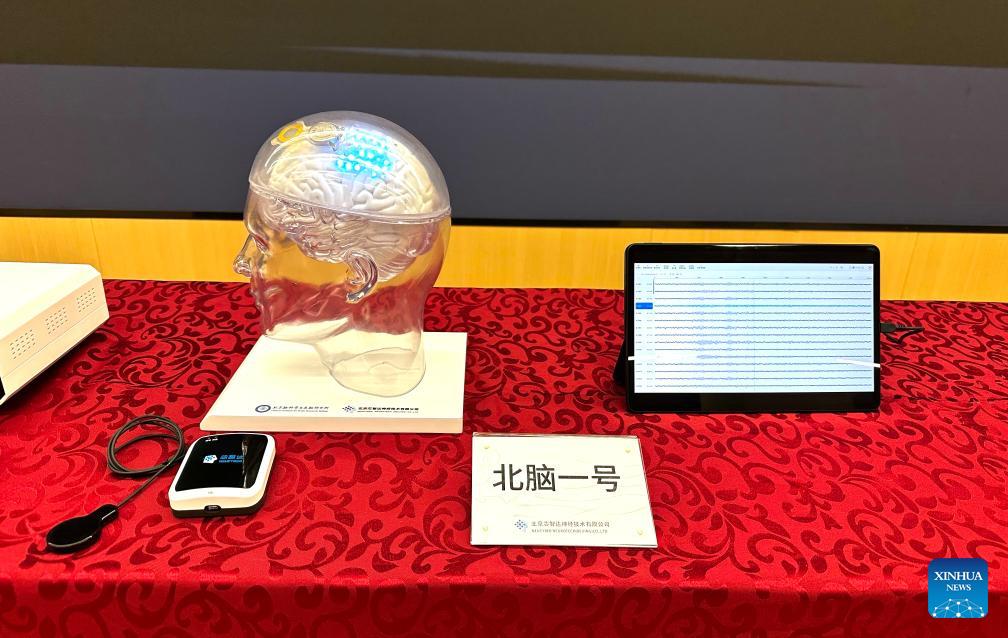
A patient who sustained aphasia due to amyotrophic lateral sclerosis has regained the ability to communicate after receiving a brain-machine interface implant, a hospital in Beijing announced on Thursday.
Doctors at the Xuanwu Hospital of Capital Medical University said they have completed the world's first human implantations of a device called the NeuCyber Matrix BMI System, which enables an aphasic patient who has lost the ability to speak to communicate, in much the same way that renowned physicist Stephen Hawking, who had ALS, was able to communicate with his speech-generating device.
The semi-invasive, wireless brain-machine interface implant was independently developed in China. It features a flexible, high-density electrode applied to the cortex that records, processes and transmits brain signals with a high sampling rate, high throughput and low power consumption.
"The device collects signals from 128 channels, or 128 different locations in the brain simultaneously, having the highest throughput among its peers," said Luo Minmin, director of the Chinese Institute for Brain Research in Beijing.
Zhao Guoguang, director of the National Center for Neurological Disorders and president of Xuanwu Hospital of Capital Medical University, said his team performed the first implantation surgery of a Chinese-language wireless brain-machine interface implant this month on a patient with ALS-induced speech loss.
The device was successfully implanted in the key area of the left hemisphere of the patient's brain that controls speech, he said at a press conference on Thursday.
The 67-year-old patient was diagnosed with ALS in 2023 and developed severe articulation disorders as the disease progressed, severely hindering verbal communication.
The surgery, assisted by a neurosurgical robot, placed a thin, flexible electrode with 128 channels on the dura mater, the outermost layer of the three membranes that protect the brain and spinal cord. The aim was to achieve high-quality neural signal acquisition with minimal trauma.
A coin-sized device responsible for control and signal transmission was then embedded on the skull surface, allowing efficient neural signal transmission through near-field communication while also supplying power, Zhao said.
The brain-machine interface device is trained to recognize brain patterns produced when certain words are internally spoken or thought. This is typically achieved by flashing a word on a screen and asking the participant to "say" it internally. Brain-machine interface algorithms then predict the words tested, according to a 2024 study published in Nature Human Behaviour.
On March 10, five days after the surgery, the patient began language decoding training. Of the 128 signal channels, 126 functioned well. After three hours of training, the real-time decoding accuracy for 62 commonly used words reached 34 percent. It has now reached 52 percent, Zhao said.
"With more training, we hope ALS patients will not only be able to communicate daily needs, but also create poetry, expressing their sentiments and feelings," Zhao said.
In other clinical trials, two paralyzed patients who received the NeuCyber Matrix BMI System implantation were able to control computers and robotic arms with their thoughts. They also controlled electrical muscle stimulation devices to recover limb motor functions.
In January, the Beijing Municipal Science and Technology Commission issued an action plan to accelerate brain-machine interface innovation in the nation's capital from 2025 to 2030. It aims for major breakthroughs in core technologies such as brain-machine interface electrodes, chips, and encoding and decoding algorithms by 2027. By 2030, the brain-machine interface industry in Beijing is expected to take shape.
The Chinese Institute for Brain Research in Beijing and NeuCyber NeuroTech (Beijing) Co have jointly developed the semi-invasive NeuCyber Matrix BMI System and the invasive NeuCyber Array BMI System, both of which have reached state-of-the-art global levels, according to the technology commission.
Last year, the NeuCyber Array BMI System, a wired version with 1,024 channels, was first demonstrated at the opening ceremony of the 2024 Zhongguancun Forum, where a monkey implanted with the device controlled a robotic arm using only its thoughts.


- Mainland slams DPP's sustained separatist agenda
- Robots expanding limits of mega projects
- Intl partnership targets poverty
- China's State Council sets up team to investigate Shanxi coal mine explosion
- Desert fighter, US friend to reunite soon
- Serbian president meets HBIS chief, backs green steel push in Belgrade





