



US tariffs to encourage China, key partners expand trade cooperation









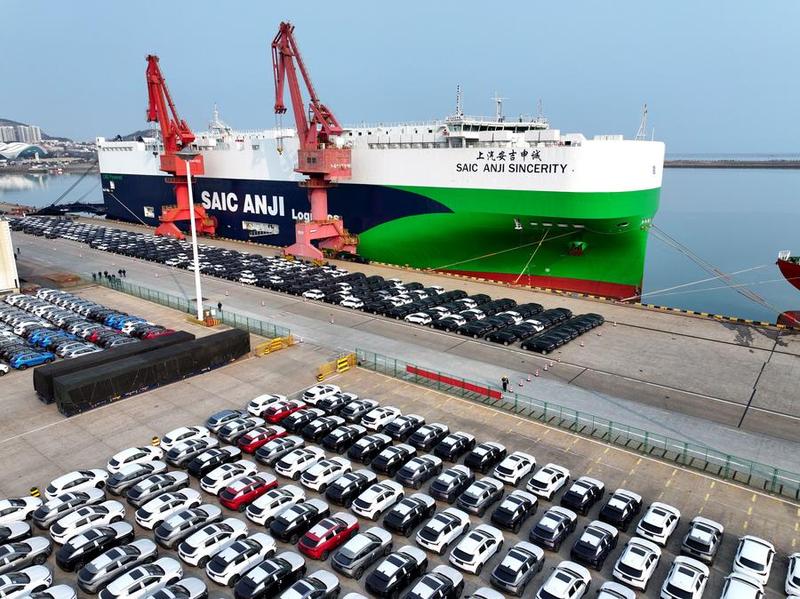
The latest round of the United States' tariff increases is likely to prompt China and its key trading partners, including South Korea, Japan, the Association of Southeast Asian Nations, and the European Union, to expand trade cooperation among themselves to sustain foreign trade and build a buffer against rising unilateralism, said Chinese and foreign scholars on Thursday.
US President Donald Trump on Wednesday signed an executive order on the so-called reciprocal tariffs, imposing a 10 percent "minimum baseline tariff" and higher rates on certain trading partners.
The policy includes tariffs as high as 49 percent on imports from Cambodia, 46 percent from Vietnam, 34 percent from China, 24 percent from Japan, and 20 percent from the European Union.
This approach is expected to have a significant impact on many global economies, including China, in the short to medium term. The US government's decision signals a departure from its longstanding commitment to multilateralism and the principle of most-favored-nation treatment, effectively marking a withdrawal from the World Trade Organization, said Mei Xinyu, a researcher at the Chinese Academy of International Trade and Economic Cooperation, in Beijing.
Countries and economies that view China as a competitor, such as India, are also feeling the pressure from the sweeping US tariff measures. As a result, several countries' hopes of replacing China's market position in the aftermath of the China-US trade conflict have been dashed, said Mei.
Meanwhile, trade agreements designed to isolate China, such as the Trans-Pacific Partnership, are gradually losing their relevance in the face of the US' broad-based tariff push. In fact, the Belt and Road Initiative can serve as a backup and support system for the multilateral trading framework, he added.
Against this backdrop, Mei said that China is expected to strengthen cooperation with Southeast Asian countries, as well as with Japan and South Korea, to jointly address the challenges brought by the comprehensive US tariffs.
"There is also reason to anticipate that the three countries - China, Japan, and South Korea - will achieve substantive progress in deepening economic and trade cooperation and in jointly managing risks, with concrete measures to follow," he said.
John Keane, a professor of politics at the University of Sydney, said the real loser in this situation will likely be the US. By targeting major global economies and imposing steep tariffs on Chinese exports, the US risks facing significant blowback.
"I believe even US economists are starting to acknowledge this. These measures could lead to higher costs for goods and commodities, directly impacting people's incomes and fueling inflation," said Keane.
While Washington promotes the idea of "reindustrializing" as a strategic response, many economists are skeptical. The reality is that today's most advanced industrial investments are deeply embedded in complex global supply chains. Take the electric vehicle sector for example, the notion that the US could quickly catch up and compete with companies such as BYD and other leading Chinese manufacturers is a joke, he added.
Echoing that sentiment, Chen Wenling, former chief economist at the China Center for International Economic Exchanges, said China should continue to support businesses to expand their global presence, leveraging their industrial strengths and global operational capabilities to reconfigure global industrial and supply networks.
This, she said, is not only a strategy to counter trade wars, but also a step toward a higher level of openness and deeper engagement with the global economy.











