



Tariff war against world will likely make US fall again









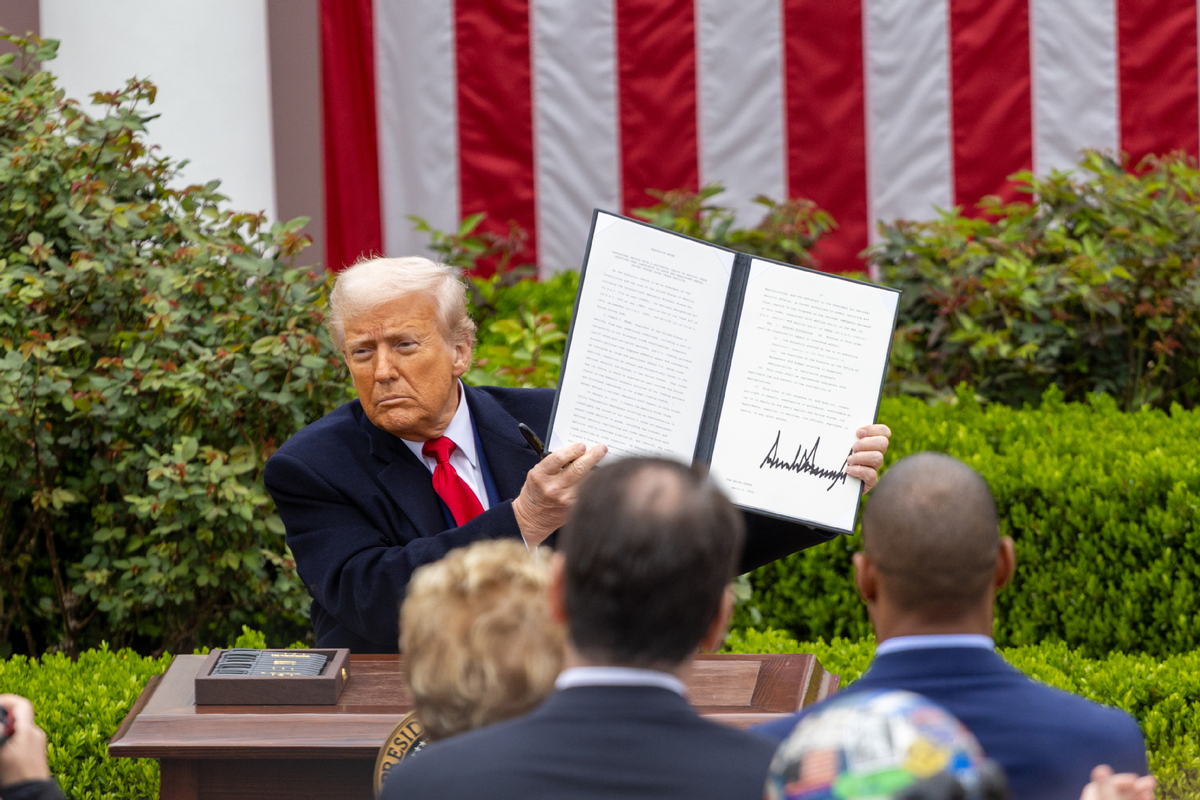
Although the United States administration has tried to make the additional tariffs it is imposing on countries look somewhat lenient by calculating them based on how each country taxes goods from the US, and making the rates lower than the "reciprocal" level the US president threatened, the impact of the tariff hikes announced on Thursday will nonetheless be comparable to the country dropping a nuclear bomb on the world trade system, as some observers have said.
The US leader eyes what he describes as "discounted" tariffs as a quick-fix for the US' chronic economic woes. But that is actually a mission impossible. The ramifications of the move will be profound as the US' trade aggression will necessarily prompt retaliatory measures from those countries hit by the castigatory tariffs, seemingly imposed on them for having the affront to trade with the nation.
The US will soon find itself caught on a horn of dilemma of its own making, as it will not be immune to the effects. The shock waves will be felt throughout the multilateral trading system, and the operational costs of the world economy will soar. The protectionist, unilateral and bullying tariff policy, which will have a boomerang effect on the US economy, will not address the US' trade deficit nor federal deficit, nor will it revitalize US manufacturing, which is simply a crumb of hope thrown to those supporters struggling to make ends meet.
Under the World Trade Organization system, the principle of "reciprocity" does exist, but it does not mean absolute equivalence in tariffs. The WTO's principle of reciprocity emphasizes a comprehensive balance to ensure that all members can benefit from the overall trade system, rather than simply matching tariff figures one-to-one in bilateral trade relations, nor does it signify equivalence in bilateral trade volume. While the WTO's principle of reciprocity seeks to foster fair and balanced trade relationships among member countries, the US administration's unilateral tariff policies are subverting this ethos. By weaponizing tariffs in a bid to strong-arm concessions from the US' trading partners, the US administration is erecting an unfair and unbalanced trade regime, destabilizing the multilateral trading system and flouting the WTO's foundational rules.
The US administration pretends to be blind to the fact that the tariffs in place under the WTO framework are the result of negotiations based on the principle of reciprocity by members through a "market for market" approach. The WTO also requires continuous advancement of trade negotiations to achieve dynamic equivalence. In comparison, the concept of "equivalence "defined by the US administration is extremely prejudiced and its acting accordingly will necessarily backfire.
The armchair strategists in Washington's narrow understanding of reciprocity and obsession with "America First" have spurred the US to weaponize tariffs without thinking about the broader consequences. Nor do they seem to realize the US will not be immune to the consequences.
As the European Central Bank predicts, if the Europe Union retaliates against the US' measures, the US GDP could fall by 0.5 percent. And the International Monetary Fund also warns the trade tensions triggered by the tariff war could set back US economic growth. The rich guys who have bankrolled the US president may not feel the heat, but ordinary Americans will, and they are unlikely to take kindly to the broken promise that things will get better.
The US' sizable trade deficit in goods is due to the imbalance of its domestic finances and the international currency status of the US dollar. The US president hopes to strengthen the international currency status of the US dollar to obtain "seigniorage" on the one hand and achieve a better trade balance on the other hand, which is fundamentally against the law of the market.
The sweeping tariff war the US administration has launched might prove a watershed for the US, making April 2 anything but "Liberation Day" as the US leader declared.











