



Unmanned vehicles to boost last-mile delivery efficiency









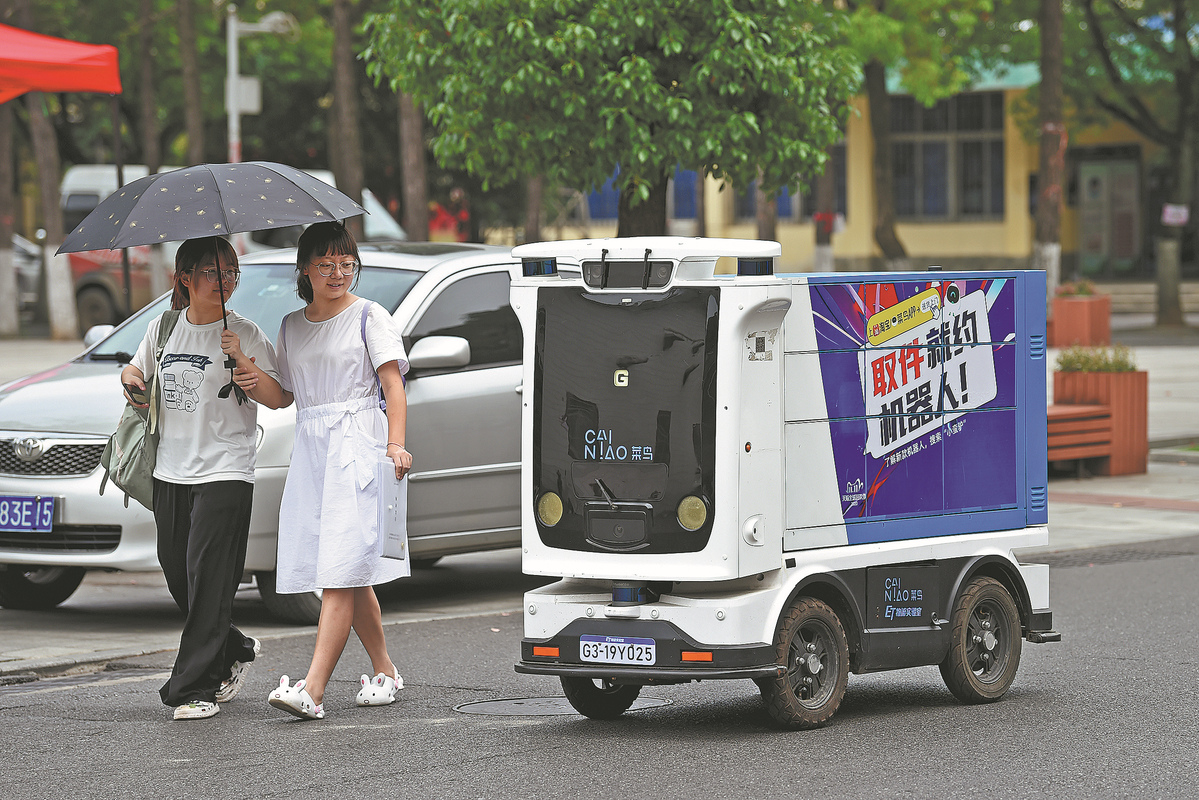
Chinese technology companies are accelerating steps to use autonomous delivery vehicles in the logistics and distribution sector, as part of a broader push to boost efficiency and address challenges from rising labor costs and a shortage of couriers.
Cainiao Group, the logistics arm of Chinese technology heavyweight Alibaba Group Holding Ltd, recently launched its latest Level 4 autonomous vehicles to facilitate parcel deliveries between delivery and pick-up stations on public roads.
The vehicles have significant improvements in terms of appearance, algorithm optimization and interactive experience compared with previous versions. Level 4 autonomy means vehicles can drive themselves in most conditions without a human backup driver.
Cainiao has invested heavily in the research, development and operation of unmanned delivery vehicles since 2016, aiming to boost last-mile delivery efficiency and cut operational costs for courier stations.
"In the next three to five years, we expect over 200,000 unmanned vehicles to be deployed in the logistics industry, which will further drive technological advancement and cost reduction across the sector," said Li Qiang, chief technology officer of Cainiao, adding that autonomous vehicles have achieved commercialization and large-scale application in the logistics sector.
Li said, Cainiao is optimistic about the unmanned vehicle market and aims to bolster the development and transformation of the logistics industry by leveraging its strengths in intelligent technologies covering artificial intelligence and autonomous driving.
The company has accumulated more than 5 million kilometers of self-driving experience on closed, semi-closed and public roads, delivering over 40 million parcels using autonomous vehicles. Its Level 4 driverless delivery vehicles have been deployed in more than 30 counties and municipal-level regions.
For instance, in Yuhang district of Hangzhou, Zhejiang province, a fleet of over 20 Cainiao unmanned vehicles handle last-mile deliveries. This is the largest fleet of its kind at a single station. These vehicles can deliver more than 30 percent of the depot's parcels, with each vehicle handling at least 1,500 packages daily.
JD Logistics, the logistics division of Chinese e-commerce giant JD, said over 600 logistics autonomous vehicles have been put into operation in 30 cities nationwide, covering a wide range of delivery scenarios including communities, shopping centers and office buildings.
Moreover, the Beijing-based company has used drones to reach consumers in some hard-to-reach remote areas for distribution purposes.
The drones can take off automatically from regional delivery stations, follow a predetermined route to villages or rural areas, land at designated drop-off points and present orders directly to customers, thus significantly shortening delivery time and reducing logistics costs.
Lu Zhenwang, CEO of Shanghai-based Wanqing Consultancy, said compared with traditional practices, unmanned delivery vehicles feature lower delivery costs and greater safety records, and have been deployed in some designated areas and scenarios, considering the limitations of current autonomous driving technologies and complicated traffic situations.
Lu said Chinese tech companies have invested heavily in the intelligent logistics sector, including driverless vehicles, drones and robots, to gain the upper hand amid fierce competition. However, it will still take time for unmanned delivery services to become commercialized on a broad scale, he added.
Mo Daiqing, a senior analyst at the Internet Economy Institute, a domestic consultancy, said the adoption of autonomous delivery vehicles can potentially reallocate couriers' working time by releasing them from parcel delivery and giving them a chance to spend more time on customer service and maintenance of vehicles.
Market consultancy iResearch said, Chinese consumers are increasingly embracing on-demand consumption and purchasing, with fruits, vegetables, dairy products, meat and eggs figuring among the most commonly purchased categories.
Dada Group, one of China's largest on-demand delivery and retail platforms, has expanded its unmanned delivery network in collaboration with JD Logistics and White Rhino, an autonomous delivery vehicle developer.
Its autonomous delivery open system has been adopted by 7Fresh, JD's supermarket chain, Yonghui Superstores and Sam's Club, as the company aims to normalize the scalable use of unmanned delivery vehicles in carrying out on-demand delivery services.











