NANJING — Whenever Chen Yun misses her father, she gazes at a photo from his 94th birthday celebration in the hospice ward of Jiangsu Province Hospital in East China. In the picture, her father, wearing a birthday hat, smiles as he enjoys longevity noodles, surrounded by dishes like ribs and tofu, and a birthday cake.
In April 2024, Chen's father was urgently hospitalized due to cancer-related pleural effusion. He was struggling to breathe and unable to lie down.
The hospice team, including geriatrics, oncology and nutrition specialists, swiftly intervened with a thoracic puncture to drain the pleural effusion, restoring his ability to rest and sleep. They adjusted his chemotherapy dosage to suit his age and tolerance, focusing on symptom control and comfort rather than eliminating cancer cells. Paired with pain relief, this strategy stabilized his condition and eased the breathing difficulties.
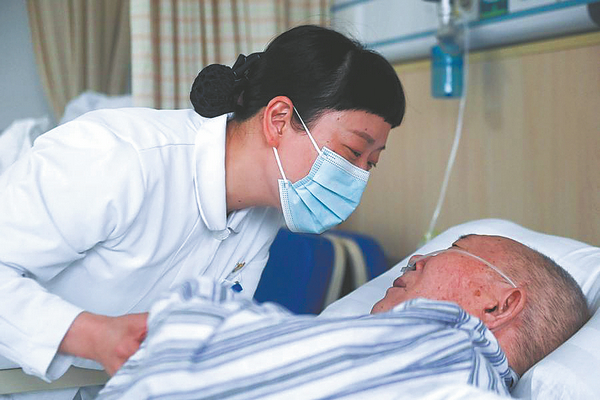
In hospital, nurses monitored his condition daily, offering comfort and guidance whenever he felt fearful or anxious, thus improving the health of the patient both emotionally and physically. He regained strength and began walking around the ward, while his appetite returned.
After nine months, Chen's father passed away peacefully in the ward. "We thought he had only days left after the diagnosis, but the hospice team gave us another precious nine months," Chen says. "My father passed away painlessly in his sleep, leaving us with no regrets."
Hospice care, which provides comprehensive support for the terminally ill and elderly, aims to manage pain, improve quality of life, and ensure a decent, peaceful passing through multidisciplinary care.
Driven by rising quality of life and education levels, more patients and families in China are seeking hospice services, with decisions by patients to forgo treatment being respected when their quality of life can no longer be guaranteed, according to Duan Yu, director of the geriatric medicine department at the hospital.
To bolster its hospice care team, the hospital has gathered over 300 medical professionals from geriatrics, oncology, pain management and other fields to form an interdisciplinary clinical team. They also promote hospice care concepts across the hospital through consultations and referrals.
Beyond clinical duties, Duan and her colleagues are committed to educating medical students on hospice care, thereby disseminating hospice concepts and knowledge to future medical workers.
Yet, China's aging society still faces a significant gap in terms of hospice care access, with less than 7 percent of patients having received such services by late 2023, notes Wang Yan, president of Xiamen Cardiovascular Hospital, Xiamen University, in East China.
Since 2019, Jiangsu Province Hospital has partnered with more than 20 hospitals and community health centers to establish a two-way referral system, linking hospitals with communities and families.
Through training, community medical teams can provide basic symptom control, such as pain relief, sedation and bronchodilation, as well as care services like feeding and cleaning. If patients opt for community or home care, doctors can refer them for transfer to nearby qualified facilities.
A cancer patient, diagnosed at the provincial hospital, wished to spend his final days at home. The hospital collaborated with a community facility to develop a follow-up plan for the patient, including regular checkups and medication adjustments. With a pain-relief pump in place, the patient returned home, celebrated his birthday with family, and later passed away peacefully.
Since 2017, China's National Health Commission has launched hospice care pilot programs in 185 cities and districts. Many local governments are prioritizing hospice infrastructure. The city of Nanning, South China's Guangxi Zhuang autonomous region, aims to have at least one hospice area per county or development zone by 2025, while Beijing plans to provide 1,800 hospice beds by the end of this year.
The Third People's Hospital of Zhenjiang in Jiangsu province is set to open a new building with about 140 hospice beds this year. This beige structure will feature a brick walkway leading to a serene garden and lake with ducks swimming in it.
Ge Chunhua, head nurse of this hospital's hospice department, looks forward to the opening of the new building, because patients there will be able to immerse themselves in natural surroundings to gain comfort.
"Patients often feel lonely and helpless at life's end. Even a simple touch or conversation can bring them strength," says Ge. "My job is really meaningful, as it can support patients through their final passage in peace and dignity."
Xinhua