


Living in peace with pangolins
Population of protected species on the rise after years of conservation efforts










Editor's note: As protection of the planet's flora, fauna and resources becomes increasingly important, China Daily is publishing a series of stories to illustrate the country's commitment to safeguarding the natural world.
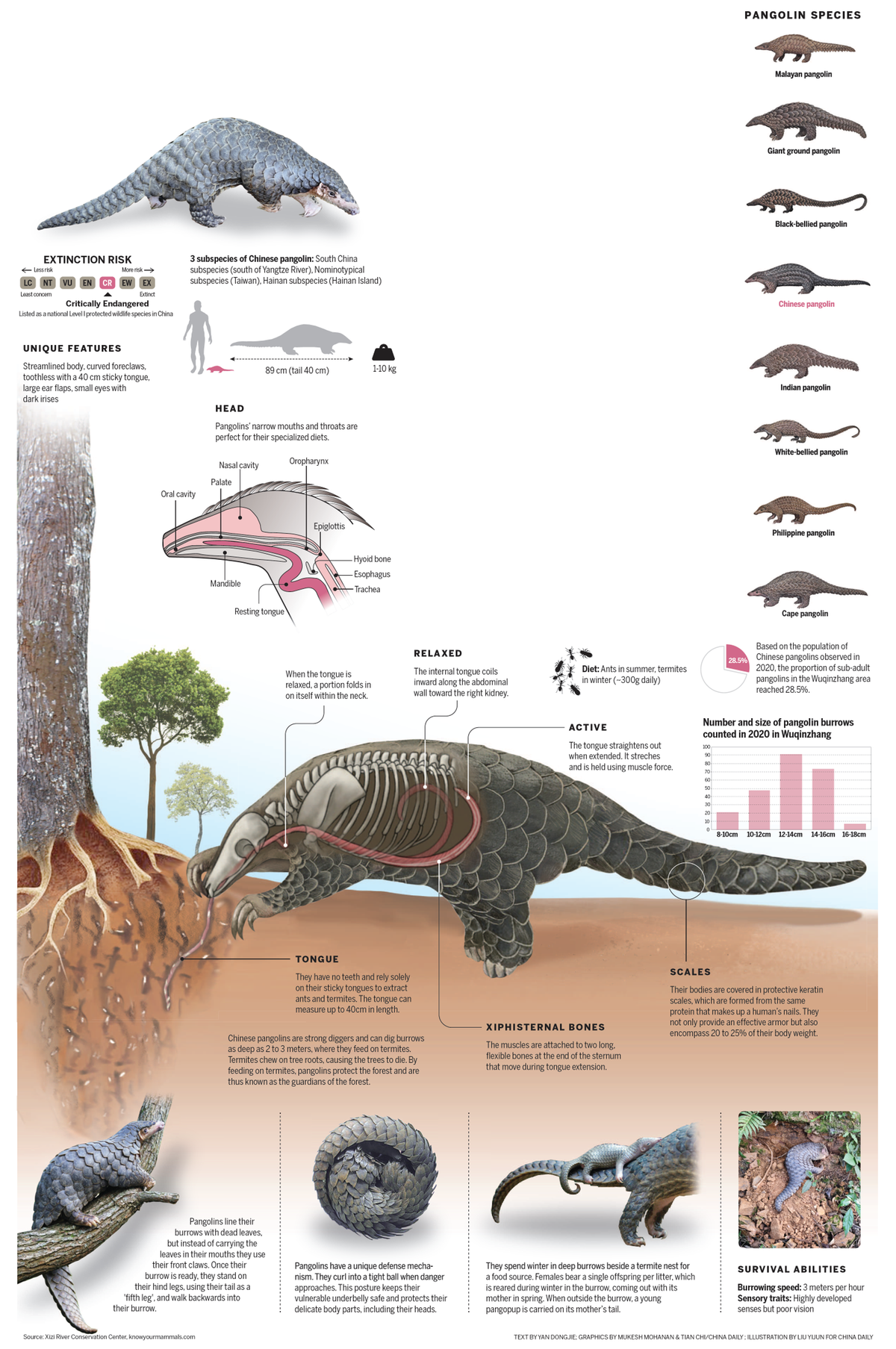
In the lush forests of Huidong county, Guangdong province, a quiet revolution is unfolding.
Once teetering on the brink of extinction, Chinese pangolins — scaly, ant-eating mammals — are slowly increasing in number here, thanks to a decadelong grassroots conservation effort that blends science, community engagement and ecological restoration.
The Huidong Wuqinzhang pangolin reserve, a 120-square-kilometer sanctuary bordering the Pearl River Delta, has become a lifeline for the species. Li Cheng, project director of the Xizi River Conservation Center, said that infrared camera monitoring shows pangolin activity has expanded from deep in the wilds to closer to villages, with even roadside burrows spotted.
"Their estimated population here now exceeds 100 — a fragile but critical recovery," said Li, who recently witnessed a mother pangolin and her pangopup at a burrow entrance, their tails entwined. "These 'forest architects' are reclaiming their role in the ecosystem."
Decades of poaching and habitat loss had reduced China's wild pangolin numbers to below those of giant pandas. But since 2018, coordinated anti-poaching patrols and village education campaigns have slashed illegal hunting.
Xu Zhuduo, a reformed former hunter turned ranger, patrols daily to document pangolin burrows. "I used to trap them. Now, villagers call us when they spot pangolins," he said, recalling his awe at discovering a burrow with newborn pups last spring.
The conservation model here emphasizes coexistence. Zuokeng village in the reserve has transitioned to eco-tourism and pesticide-free rice farming, with pangolins becoming an unlikely mascot for sustainable development.
Education has been the driving force behind the cultural shift. Sixth-grader Xu Yiqin confidently explained: "Pangolins are national first-class protected animals. They eat termites, saving forests." Her classmate Xu Zhifeng added, "Saving water protects their homes."
Critical infrastructure adaptations have also aided the efforts. An experimental wildlife corridor bridges a hydropower canal that once fragmented habitats. Infrared footage confirms pangolins, leopard cats and boars now traverse the structure. "It's about balancing development and conservation," Li said.
As dusk falls over the reserve, the rustle of pangolins digging echoes through valleys — a testament to a community rewriting its relationship with nature.
Wang Demin contributed to this story.
Contact the writers at yandongjie@chinadaily.com.cn





