



Key schools to launch low-altitude economy major









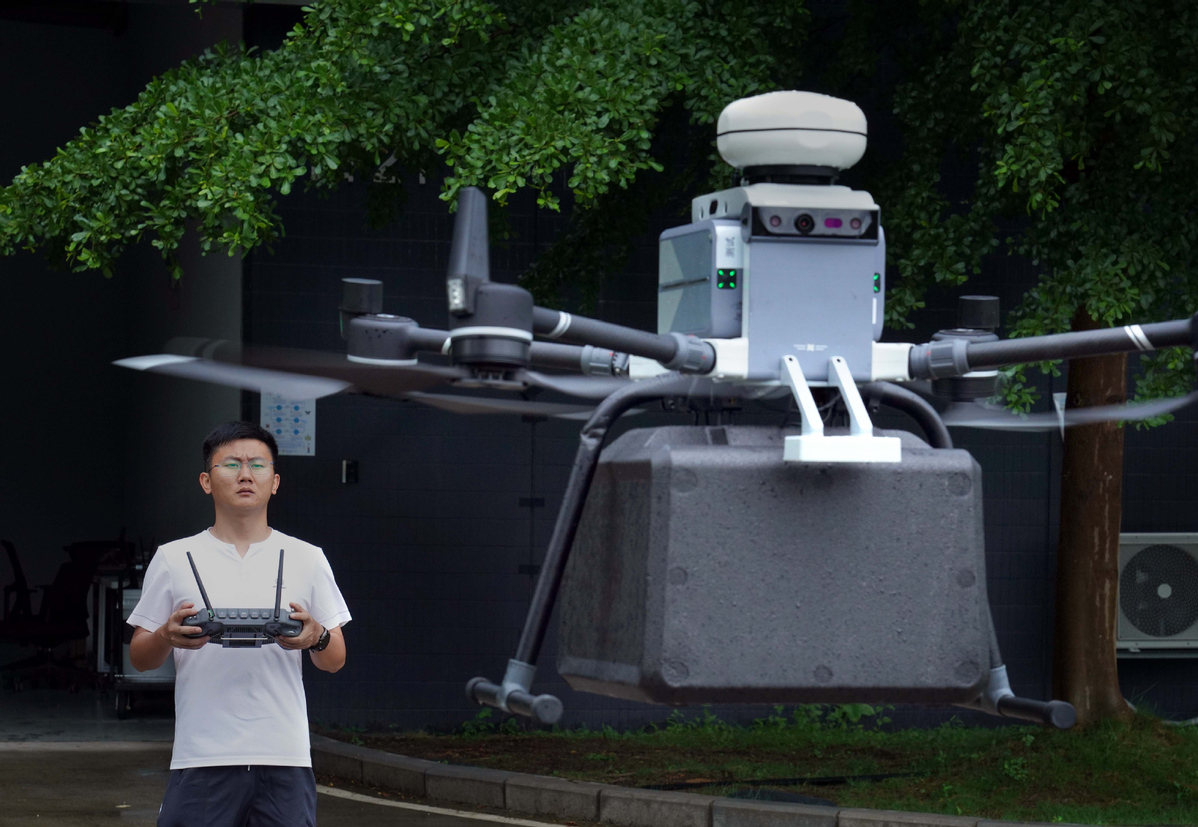
In a major move to address the strategic demands of China's burgeoning low-altitude economy, six top universities have jointly launched an undergraduate program in the sector, expecting to enroll new undergraduates for the upcoming fall semester.
Approved by the Ministry of Education and added to China's national catalog of undergraduate programs in April, the program represents an urgent national effort to cultivate talent for an industry poised to reach 1.5 trillion yuan ($209 billion) this year.
The six institutions are Beihang University, the Beijing Institute of Technology, Beijing University of Posts and Telecommunications, Nanjing University of Aeronautics and Astronautics, South China University of Technology, and Northwestern Polytechnical University.
The low-altitude economy refers to activities that take place in airspace below 1,000 meters, including low-altitude flight, air tourism, passenger transportation and general aviation.
"In the future, our daily commutes, package deliveries, or even ordering a cup of coffee will likely be closely linked to the low-altitude airspace economy," said Luo Mingqiang, vice-dean of Beihang University's School of Aeronautic Science and Engineering. He also noted current applications such as drone-based pesticide spraying, power line inspection and delivery of medical supplies.
The coordinated rollout of the undergrad major follows the formal inclusion of the low-altitude economy in China's 2024 Government Work Report and the establishment of a dedicated low-altitude economy department at the National Development and Reform Commission.
In order to facilitate a more agile response to national strategies and cater to newly prioritized strategic areas, the Ministry of Education implemented a new mechanism allowing swift adjustments to the 2025 undergraduate major catalog, and the low-altitude airspace major was included.
The Civil Aviation Administration of China has forecast that the domestic low-altitude economy market will reach 1.5 trillion yuan this year, expanding further to 3.5 trillion yuan by 2035. The anticipated growth has intensified demand for specialized talent.
Luo, the vice-dean from Beihang University, expects widespread integration of low-altitude space technologies into daily routines within two to three years. He said these technologies could become as commonplace as cars or smartphones by around 2035, driven by infrastructure development and breakthroughs in core technologies like energy and electronics.
Dong Leiting, Party secretary of Beihang University's School of Aeronautic Science and Engineering, said the distinctive features of the school's major in low-altitude airspace technology and engineering include multiparty investment, work-integrated learning and an international perspective.
Interdisciplinary program
Beihang's new program emphasizes interdisciplinary collaboration, thereby leveraging the university's strengths in aeronautics, astronautics and artificial intelligence, he added.
"We aim to cultivate talent capable of excelling globally," Dong said.
He also said that students in the major represent talent who can be nurtured to tackle major national needs. "We hope to cultivate students who not only understand aircraft, but also their control and operation and, finally, the relevant economics, laws and regulations."
Similarly, Beijing University of Posts and Telecommunications has leveraged its core competencies to develop the new major.
Gu Rentao, a deputy director of the university's academic affairs office, said the university's low-altitude technology and engineering major is an interdisciplinary program jointly developed by its leading disciplines in information and communication engineering, computer science and technology, control science and engineering, and intelligent science and technology.
The program concentrates on integrating theory and practice, particularly emphasizing research and development as well as the application of unmanned, networked and intelligent systems in the sector of low-altitude technology.
"Communication perception and computational intelligence technology form the crucial foundation of the low-altitude economy, supporting nearly all its directions," Gu said. The program aims to cultivate talent capable of solving complex engineering problems using skills in communication, computational intelligence and automatic control.
Beijing University of Posts and Telecommunications plans an initial enrollment of 60 students, seeking to draw those interested in applying interdisciplinary knowledge to the innovative field.
Gu underscored the significant talent gap within the low-altitude industry, which ranges from drones and electric vertical take-off and landing aircraft to air traffic management and smart logistics.
He anticipates extensive employment opportunities for graduates in areas such as intelligent low-altitude equipment, low-altitude communication, target detection, navigation and air traffic control, geographic information systems and intelligent control.


- Increase in western Pacific military activities noted
- China, Pakistan pledge deeper military ties
- SPP to oversee handling of Shanxi mine explosion case
- Mine blast victims get mental health counseling
- China leads with ‘deep and real’ methane control efforts, expert says
- China calls for fair global ocean governance in Xiamen symposium





