


City turns into 'beating heart' of sensor tech
Bengbu, Anhui province, home to over 200 companies devoted to smart sensing technology; dubbed 'China Sensor Valley' by industry insiders










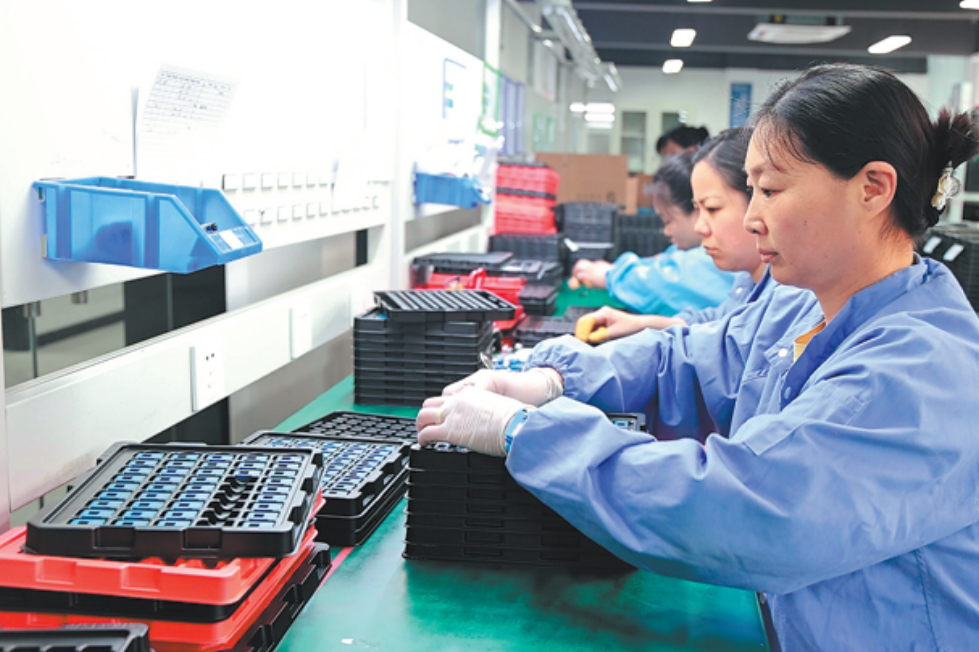
To address the bottleneck between R&D and production — a problem that plagues several deep-tech sectors in the country — Bengbu also established dual-wafer lines: one for mass production, the other for pilot testing and customization.
With such a flexible R&D and production environment, the city has already attracted 22 high-level research and innovation platforms, including a national MEMS engineering laboratory.
That full-stack approach has turned Bengbu into one of the only cities in China with both 6-inch and 8-inch MEMS wafer lines, which are capable of handling everything from small-batch prototyping to industrial-scale production.
More than 300 types of sensors are now produced in Bengbu. These are not just parts; they're enabling next-generation products in fields from autonomous driving and industrial automation to aerospace and consumer electronics.
Chen Binggen, Party secretary and chairman of Anhui North Microelectronics Research Institute Corp Ltd, a subsidiary of China North Industries Group Corp Ltd, said: "Sensor development used to be piecemeal in China, usually one firm doing R&D, another doing manufacturing.
"But here in Bengbu, we've built the full chain, from materials and chips to modules and systems. That full-stack model has helped nurture many homegrown heroes from supply chains."
For instance, in 2023, a local chipmaker successfully listed on China's STAR market, while another leading magnetic sensor firm in the city is accelerating toward its initial public offering.
The city is home to over 50 high-tech firms and 40 "little giant" companies, which refer to specialized, innovative, and fast-growing small enterprises supported by the Chinese government.
In some ways, Bengbu's transformation also reflects broader changes sweeping across China's manufacturing sector. No longer content with being the world's factory, cities like Bengbu are embracing intelligent manufacturing, where software, hardware, AI and automation blend into a single ecosystem.
Walking through Huaxin's production floor feels like entering a sci-fi novel. Overhead vehicles silently zoom past, monitored by AI algorithms that reroute traffic in real time and schedule predictive maintenance. Human intervention is nearly absent. Contamination is minimized. Efficiency is maximized.
The company said that such advanced technology helps to avoid traffic jams, to self-schedule maintenance, and to operate almost entirely without human intervention.
Industry experts said that what's happening in Bengbu is a model for how smaller Chinese cities can leverage reform, specialization and industrial focus to leapfrog into the future.
China has elevated sensor innovation to a national priority in the 14th Five-Year Plan (2021-25), investing big in research and development, talent cultivation, infrastructure development and global standard-setting.
The central government has rolled out sweeping policies that target sensor autonomy, supply chain resilience and ecosystem integration. Financial support, standardization road maps and industrial zones have also been introduced.
According to market consultancy MarkWide Research, China's sensor market was estimated at between $15 billion and $21 billion last year. The market is projected to reach $90 billion by 2035, growing at a compound annual growth rate of 16 percent to 17 percent.
Consumer electronics — smartphones, wearables and smart home devices — and automotive applications together make up more than 60 percent of the market, while industrial, medical and aerospace segments are also rapidly growing, it said.
Guo Yuansheng, executive vice-chairman of the Sensors and IoT Industry Association, said: "China has gained some momentum in sensor technology. The fully automated 8-inch MEMS wafer production line, for instance, has played a positive role in advancing the industrialization of sensors.
"Such technologies will lead and drive the domestic intelligent sensor industry clusters toward high-end development, reshaping the structure of the sensor industry chain and the overall landscape of the sector globally."





