


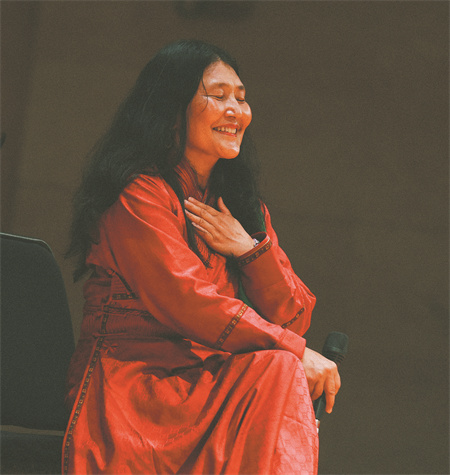
At 21, Urna left her hometown for the first time and studied the yangqin (a hammered dulcimer) at the Shanghai Conservatory of Music. It was during this time that she began her career as a singer.
While studying basic music theory at the conservatory, she found herself returning to her Mongolian roots. During the 1990s, she frequently traveled back home to collect local folk songs, which deepened her understanding of those traditional melodies.
"Each of us has our own roots. If we develop a solid foundation, there's so much room for growth. Right now, I'm singing, especially with this new album, and I'm expressing music the same way I did when I was a child," she says, adding that she is deeply grateful for her parents and her hometown. Her deep connection to folk traditions, vast landscapes, and the nomadic lifestyle has greatly influenced her sound.
Later, she traveled to Europe and collaborated with musicians from around the world, releasing seven albums, including Crossing, in 1997, where Urna worked with musicians playing instruments like the yangqin, guzheng (a traditional Chinese zither-like instrument), and sheng (one of the oldest Chinese wind instruments, often referred to as a mouth organ or free reed instrument).
In 2001, she released Jamar, an album that saw her singing alongside a diverse range of instruments, from Indian percussion to the morin khuur, or horse-headed fiddle, a traditional string instrument central to Mongolian music. In 2018, she released Ser (Awakening), in collaboration with the Polish band Kroke, featuring accordionist Jerzy Bawol, double bassist Tomasz Lato, and violinist Tomasz Kukurba.
"My music is like the grassland — there's grass, flowers, sheep, and horses. It shouldn't have just one color, nor should it be confined by any dogmatic form," Urna says. "No matter what kind of music it is, I can sing it; this is my true nature."





