



Global cooperation key to regulating AI









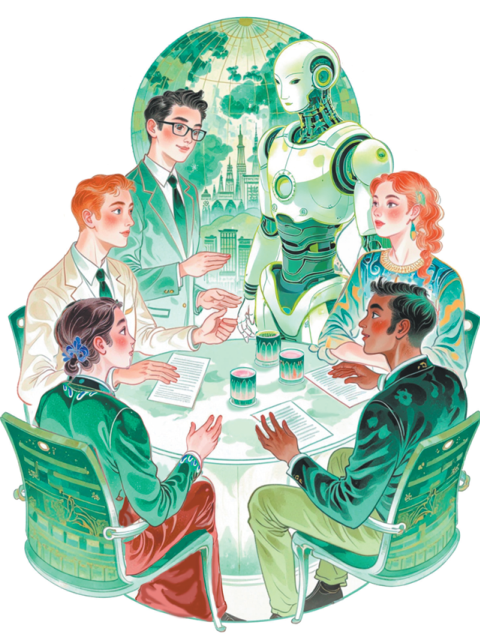
Premier Li Qiang's bold proposal at the World Artificial Intelligence Conference in Shanghai on July 26 for establishing a global organization to promote international cooperation for guiding and regulating AI promises is a milestone in using AI for the common good of humanity. At the same time, it will help prevent AI from becoming our master.
In his keynote speech, Li called for the establishment of a global framework of rules to govern AI. He emphasized that this framework be shaped by a broad international consensus and called for striking a balance between AI development and security. Also, he warned that in the absence of coordinated global governance, AI could become the exclusive domain of a few countries and companies, primarily benefiting wealthier nations while leaving others, especially countries in the Global South, behind.
Throughout his address, Li reaffirmed China's commitment to multilateralism and to sharing its AI technology achievements with the broader international community, while underscoring the importance of ensuring universal access to this transformative technology, and calling for international collaboration, including joint scientific research and open-source initiatives. His address highlighted China's commitment to playing a leading role in building a fair and inclusive global AI ecosystem.
Concurrently, China released its Global AI Governance Action Plan, which proposes that a United Nations-led international organization coordinate AI development and regulations and emphasizes the importance to uphold multilateralism, promote inclusivity and ensure equal participation for all countries. The plan envisions open-source cooperation, technology-sharing, and joint research, and accords priority to the bridging of digital divide through AI education, infrastructure and talent-cultivation such as those pioneered by Chinese companies like Huawei. Among the bedrock principles are responsible, people-centered AI with clearly defined and enforced ethical and legal safeguards.
China's plan is in sharp contrast to the United States administration's irresponsible zero-sum "Winning the AI Race: America's AI Action Plan" released a few days earlier. It is not a win-win plan to save humanity from runaway AI, but an irresponsible political diatribe against China which would further widen global divisions. It aims to create a "US AI exports program" that bundles US chips, models and standards into full-stack packages for allies, while increasing export control against "adversaries" in a policy that could split global markets, force countries to choose sides and undermine universal safety guardrails.
Not surprisingly, it even reverses the modest protections enshrined in previous US president Joe Biden's "AI Bill of Rights".
To add to the urgency, Geoffrey Hinton, considered by many to be the "godfather of AI" and 2024 Nobel Physics laureate, warned the World Artificial Intelligence Conference that advanced AI could soon surpass human intelligence and become uncontrollable. He compared super-intelligent AI to a tiger cub that grows ever more dangerous as it matures, and warned that eventually even trying to shut AI off may not work.
Hinton's plea brought back memories of Stanley Kubrick's 1968 classic and prescient film 2001: A Space Odyssey. In this science fiction movie, set in 2001 but which is still a must-see, the onboard AI computer, HAL 9000, kills several crew members due to a contradictory programming error the computer was unable to resolve. Now Hinton is afraid that life will soon be lethally imitating art.
Hinton made a passionate plea for global cooperation to align AI with human values, proposed an international safety consortium, and urged young researchers to proceed boldly but emphasized the urgent need to ensure AI remains beneficial to humans, while warning that unchecked AI could harm or replace humans if not trained within the framework of established guardrails.
It is clear to me which of the two plans Hinton thinks is urgently needed, and which one he considers an existential threat to all humanity. No wonder the 77-year-old Canadian scientist chose the WAIC for his first trip to China as the venue to emphasize the urgency of his message.
In taking the more responsible approach, China is not in uncharted territory. There is a little-known precedent, similar to what China is proposing: an organization based in Geneva, Switzerland, known mostly to scientists and policy wonks, which has an unblemished record of success. It is called CERN by its French acronym, or the European Organization for Nuclear Research, founded in 1954 by 12 European countries seeking to re-establish peaceful scientific cooperation after World War II and it is where, among other technologies, the World Wide Web was spun and touch-screen technology was invented in the 1970s, decades before smartphones came in.
CERN is governed by consensus among its 25 politically diverse member states. The organization's leadership rotates to avoid favoritism and it is known for its transparency and open decision-making. Knowing how thorough the Chinese government's decision-making is, it's likely that CERN was considered when Premier Li proposed at the WAIC the establishment of a global organization to promote international cooperation.
I hope that for the sake of humanity this important proposal is swiftly implemented. Time is of the essence, and, once again, China is leading the way forward.
The author is a senior fellow at the Center for China and Globalization.
The views don't necessarily reflect those of China Daily.
If you have a specific expertise, or would like to share your thought about our stories, then send us your writings at opinion@chinadaily.com.cn, and comment@chinadaily.com.cn.





