



Mutual trust reaffirmed in visit
Pledge to consolidate coordination seen as boosting shared prosperity









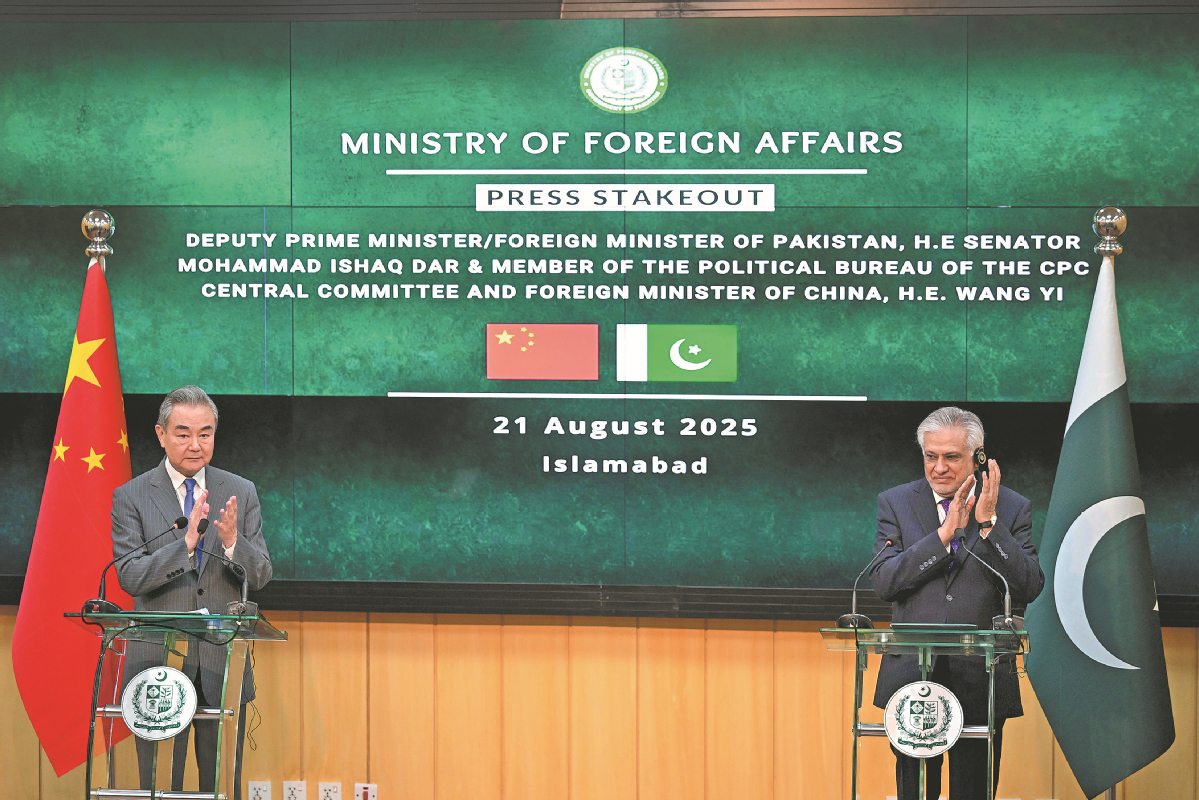
Beijing and Islamabad have pledged to upgrade the China-Pakistan Economic Corridor and consolidate their strategic trust and coordination, a move officials and experts say will not only deepen bilateral ties but also set an example for regional peace, stability and shared prosperity.
The consensus was reached as Chinese Foreign Minister Wang Yi and Pakistani Deputy Prime Minister and Foreign Minister Mohammad Ishaq Dar co-chaired the sixth round of the China-Pakistan Foreign Ministers' Strategic Dialogue in Islamabad on Thursday.
According to China's Foreign Ministry, the two sides will build on past achievements by promoting five new corridors — growth, livelihood, innovation, green and openness — while deepening cooperation in industry, agriculture and mining. The effort aims to enhance Pakistan's development capacity and strengthen its economic resilience.
Launched in 2013, the CPEC, a flagship project of the China-proposed Belt and Road Initiative, has helped Pakistan improve its infrastructure and promote economic and social development.
The two countries also reaffirmed support for Gwadar Port, which is a key component of the CPEC, pledging to advance the Karakoram Highway project and welcome third-party participation in railway upgrades.
At a joint news conference, Wang reiterated that China and Pakistan are "ironclad friends" and "all-weather strategic cooperative partners" who will always stand in firm mutual trust and support.
The CPEC will not only benefit both peoples but also extend to Afghanistan and beyond, he added.
Both sides pledged to strengthen coordination, practice multilateralism and oppose unilateral bullying practices.
Dar reaffirmed that friendship remains the cornerstone of Pakistan's foreign policy. He expressed the country's readiness to work with China to advance the upgraded CPEC and to deepen cooperation in areas such as energy, information technology and connectivity.
He also assured Beijing that Pakistan will spare no effort in combating all forms of terrorism and ensuring the safety of Chinese institutions and personnel in the country.
During his stay in Islamabad, Wang was received by Pakistan's President Asif Ali Zardari, who said Pakistan fully trusts China and will unwaveringly stand by its side. Zardari called for closer coordination with China on regional and international issues to safeguard peace and development.
Support expressed
Wang emphasized that China has always placed its relations with Pakistan as a priority in its neighborhood diplomacy and will continue to firmly support Pakistan in safeguarding national sovereignty, territorial integrity and national dignity.
During a meeting with Wang, Pakistani Prime Minister Shehbaz Sharif described bilateral friendship as "unique", saying he looks forward to attending the upcoming Shanghai Cooperation Organization Summit in Tianjin, and the commemorations marking the 80th anniversary of the victory in the Chinese People's War of Resistance Against Japanese Aggression (1931-45) and the World Anti-Fascist War.
On Thursday in Islamabad, Wang also met with Pakistan's Chief of Army Staff Asim Munir. The three-day visit was his first to Pakistan in three years and the final leg of his five-day South Asia tour, which also took him to India and Afghanistan.
At the joint news briefing, Wang said the trip reinforced his impression that South Asia has enormous development potential and momentum, noting that the 21st century should be "an era of accelerated development and revitalization for Asia, and especially South Asia".
China and South Asian countries are "natural partners with vast room for cooperation", Wang said, emphasizing that its relations — whether with Pakistan, India or other neighbors — do not target any third party, nor are they affected by any third party.
Liu Zongyi, director of the Center for South Asian Studies at the Shanghai Institutes for International Studies, said China pursues amicable relations with its neighbors, promoting mutual respect, inclusive cooperation, and win-win partnerships with South Asian countries to build a community of shared future.
"As all-weather strategic cooperative partners, China and Pakistan stand as a model of regional cooperation based on mutual trust and pragmatic collaboration," he said.
At a time of profound global and regional change, development remains the strongest common aspiration, Liu said, adding that peace, stability and shared prosperity in South Asia are essential to safeguarding the fundamental interests of all parties.










