


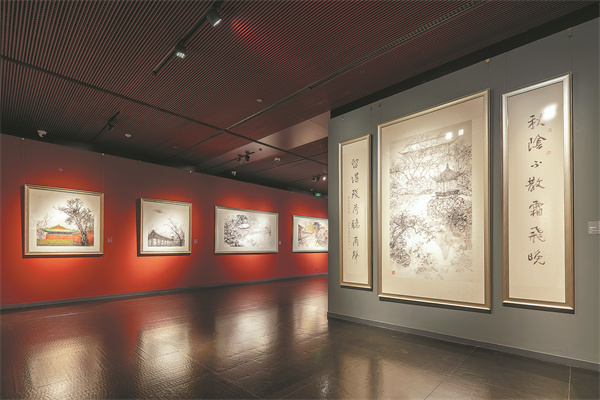
Acclaimed artist creates paintings of nature in miniature form, evoking philosophical reflections, Lin Qi reports.
Classical Chinese gardens, whether the imperial ones found in Beijing or the private residential gardens in Suzhou, Jiangsu province, have become priority destinations for those who travel the country.
The meticulous, graceful designs exhibit how the ancient Chinese attempted to recreate nature in miniature scale for daily life, using lush plants, hollowed rocks and pavilions, bridges and corridors of fine silhouettes in the pursuit of peace, harmony and perfection.
An artist seeks to convey the same feeling when creating Chinese ink paintings. The style is half realistic, depicting landscapes and lives in the real world, and half imagined to underscore one's life ideals and yijing, or artistic conception.
At acclaimed ink artist Wang Mingming's ongoing exhibition at the National Centre for the Performing Arts in Beijing, he combines these two representative examples of classical Chinese artistry with his poetic strokes.
The Spiritual Realms in Ink exhibition, running until Oct 8 in NCPA's west exhibition hall, displays nearly 100 paintings that Wang has created in recent years to celebrate the understated beauty and supernatural atmosphere of Chinese gardens, as well as the philosophical outlook on the relationship between humans and nature embodied in the rich details of garden design.
Wang, born in 1952 in Beijing, was praised as a child prodigy, whose paintings won children's art prizes and were featured in news outlets and magazines.
Because of his gift, Wang, in his early teens, was introduced to prominent art figures, such as Li Kuchan and Wu Zuoren, who mentored him in improving his techniques and taught him the importance of accumulating cultural knowledge to achieve high artistry.
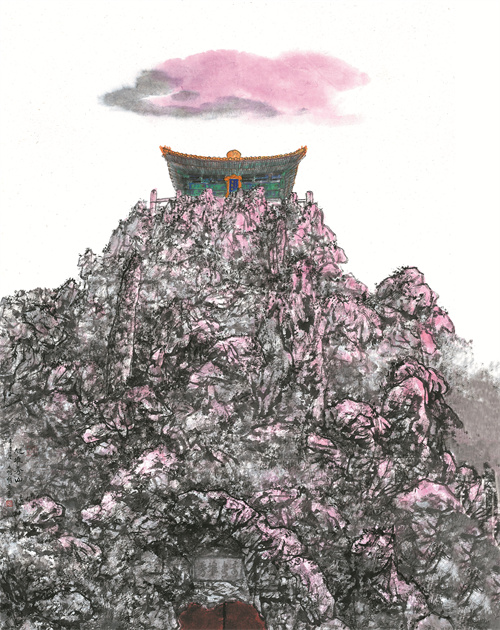
Wang became a professional artist at the Beijing Fine Art Academy in 1978 and worked there for decades, later undertaking the role of director of the institution for years. Retirement has allowed him more time to indulge himself in the carefree world of layered strokes and shaded colors.
Works in the current show were primarily created after he retired from the art academy.
Wang says that when he considered the exhibition's title, a phrase came to mind — "weidao jixu" — from Zhuangzi, a compilation of classic texts named after its author, a Taoist philosopher who lived during the fourth and third centuries BC.Weidao jixu means that the dao (Tao) gathers in emptiness.





