



Alibaba, Nvidia team up for Physical AI









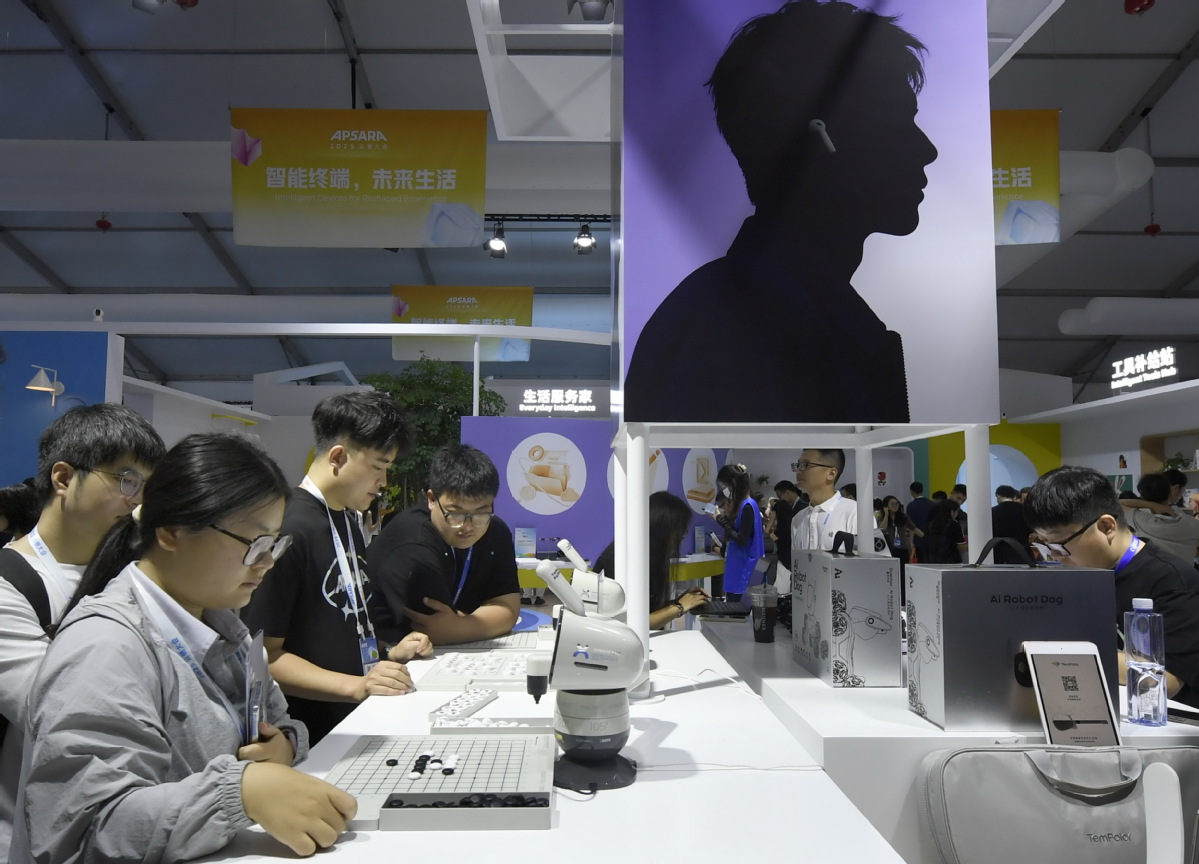
Chinese tech heavyweight Alibaba Group Holding Ltd has announced a partnership with US tech firm Nvidia in Physical AI, and vowed to increase investments in artificial intelligence infrastructure and capabilities.
This comes as the Chinese tech company doubles down on AI as a core strategy and aims to bolster technological advancements in AI.
The AI platform of Alibaba Cloud, Alibaba's cloud computing unit, will integrate Nvidia's Physical AI software to provide enterprise users with data preprocessing, synthetic data generation, model training and evaluation, and robot reinforcement learning, while significantly shortening the development cycle for embodied intelligence technology, assisted driving, and other applications.
The announcement was made during the Apsara Conference 2025 in Hangzhou, Zhejiang province on Wednesday.
Physical AI refers to the integration of AI into autonomous systems, enabling them to perceive, understand and perform complex actions in the physical world. Unlike traditional AI, which primarily processes data such as text or images, Physical AI focuses on spatial relationships and the physical behavior of the 3D world.
Meanwhile, Alibaba Cloud unveiled its most powerful artificial intelligence model, Qwen3-Max, at the conference. The AI model boasts over 1 trillion parameters, and demonstrates particular strengths in code generation and autonomous agent capabilities, marking a new breakthrough in the fast-developing AI technology.
Autonomous agent functionality means that the AI system can make independent decisions and finish tasks independently with minimal human intervention. The advancement reinforces Alibaba's ambition to compete directly with leading Western counterparts while accelerating innovation in China's sprawling AI ecosystem, experts said.
Wu Yongming, CEO of Alibaba Group, and chairman and CEO of Alibaba Cloud Intelligence, said the company will further increase investments — from its previously announced 380 billion yuan ($53.4 billion) — in AI and cloud infrastructure over the next three years, though he did not specify the amount.
Wu highlighted that the speed of AI industry development and the demand for AI infrastructure have far outpaced expectations.
"In the future, large AI models will be deeply integrated into a wide range of devices, functioning like operating systems — equipped with persistent memory, seamless cloud-edge coordination and the ability to continuously evolve," Wu said.
"We remain committed to open-sourcing Qwen and shaping it into the 'operating system of the AI era', empowering developers around the world to build transformative AI applications."
Simultaneously, Alibaba Cloud is strategically positioned as a full-stack AI service provider, and is dedicated to delivering robust computing power for training and deploying large AI models on the cloud, Wu added.
The company has also unveiled other AI models, covering visual language and multimodal processing capacities. Since the launch of the first generation of Qwen in 2023, Alibaba has open-sourced over 300 AI models built on its two foundation models.
With over 600 million downloads and 170,000 derivative models created, Alibaba's AI models have become one of the most widely adopted open-source AI series globally.
Charlie Dai, vice-president and principal analyst at research company Forrester, said Alibaba is positioning itself as a foundational player in the era of agentic AI by being committed to a global open-source ecosystem, and the strategic focus and investment underscore its intention to power AI innovation in the global market.
"This move will intensify competition in foundation models and AI-native clouds, and it will also push the industry toward open ecosystems," Dai said.
For Chinese AI firms, key investment areas should take an outcome-driven approach, targeting model fine-tuning and vertical agentic AI solutions, Dai said.
An increasing number of enterprises are seeking to bolster digital transformation and upgrading, and improve operational efficiency through the adoption of AI technology, which brings immense business opportunities for Alibaba and provides strong support for its business growth, said Jiang Han, a senior analyst at market consultancy Pangoal.
The company's increased investment in AI will propel the application of such cutting-edge technology in a broad range of sectors, while motivating other tech companies to pool more resources into research and development and technological innovation amid intensifying competition in the AI field, Jiang said.
According to a report from global consultancy McKinsey & Co, generative AI will add between $2.6 trillion and $4.4 trillion in annual value to the global economy, resulting in a significant impact across all sectors of industry.
fanfeifei@chinadaily.com.cn











