


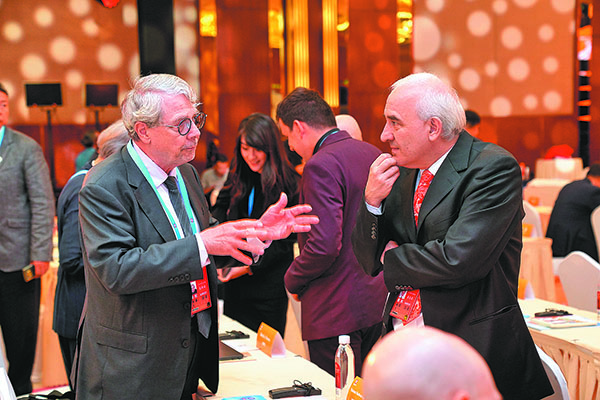
Digital technology is empowering the protection and utilization of cultural relics, while also raising new challenges for communication, according to speakers from China and abroad at a parallel panel during the 2025 Beijing Culture Forum on Tuesday.
"Preservation and Inheritance: Digital Empowerment for Cultural Heritages", held as part of the two-day forum in Beijing, brought together experts and heritage professionals to explore the growing role of digital tools in cultural heritage preservation.
Rao Quan, director of the National Cultural Heritage Administration, notes that the current wave of digitization is merging with economic and social development at an unprecedented speed and scale. Digital technologies, he says, are not only reshaping traditional modes of production and daily life, but also accelerating shifts in human cognition. At the same time, they are opening significant new avenues for the protection of cultural heritage.
He explains that digital management of relics has become increasingly widespread, allowing for more standardized, systematic and efficient collection and storage.
The Palace Museum in Beijing, for instance, has created digital records for over 1 million artifacts. The Dunhuang Academy, which oversees World Heritage Site Mogao Caves, has compiled digital information on 300 caves, and Longmen Grottoes Academy has established digital protective archives for 52 of the key caves of the Longmen Grottoes, another World Heritage Site. These resources, Rao says, provide valuable references for long-term protection.
Digital technologies are also enhancing how visitors engage with cultural heritage. Chu Xiaobo, director of the Shanghai Museum, highlights the success of the digital exhibition Poetic Jiangnan (referring to the southern regions of the lower reaches of the Yangtze River) organized last year.
Drawing on two decades of research into ancient Chinese paintings, curators used digital tools to build an immersive environment that traced the evolution of Jiangnan landscape paintings from the Five Dynasties and Ten Kingdoms (907-960) to the Qing Dynasty (1644-1911).
"Since opening, the exhibition has been warmly received by visitors, especially families and international tourists, becoming a popular 'check-in spot' in the museum," says Chu.
Last year, Beijing Central Axis, an ensemble of palaces, ceremonial and public buildings, roads and other aspects governing the overall layout of the old city area of the Chinese capital, was listed as a UNESCO World Heritage Site.
To bring its history closer to the public, the Beijing Central Axis Heritage Conservation Center, led by its director Jin Xibin, developed the WeChat mini program Cloud Central Axis, which uses cloud technology to let users experience the past and present of the axis from their phones.
Through the app, users can have a bird's-eye view of the city's changing layouts, hear the sounds of bells and drums echoing through the old streets, or "fly" over the landscape to appreciate the ancient wisdom behind Beijing's selection as the imperial capital.
This year, an English version of the program was also launched.
"The program connects the axis with a wider audience and enables fine traditional Chinese culture to reach abroad in a more vivid and lively way," says Jin.
Yet, alongside these advances come new challenges. Matthieu Guevel, UNESCO's director of communications, warns that the increasing sophistication of digital tools complicates the communication of academic findings. Big data, he explains, can reinforce pre-existing views rather than open new perspectives.
"If in the past we were separated by physical walls, now we are overwhelmed by information. What stands before us are not towering walls, but mirrors. Our screens are no longer windows opening to the world, but mirrors that only reflect what's already in our minds.
"Algorithms reinforce our viewpoints by continuously pushing content that aligns with them, and we interact only with people who share our opinions, thus narrowing our perspectives," he says.
Now the challenge is, how to translate academic discoveries into proper expressions on open platforms, making them accessible to a broader audience, he adds.





