


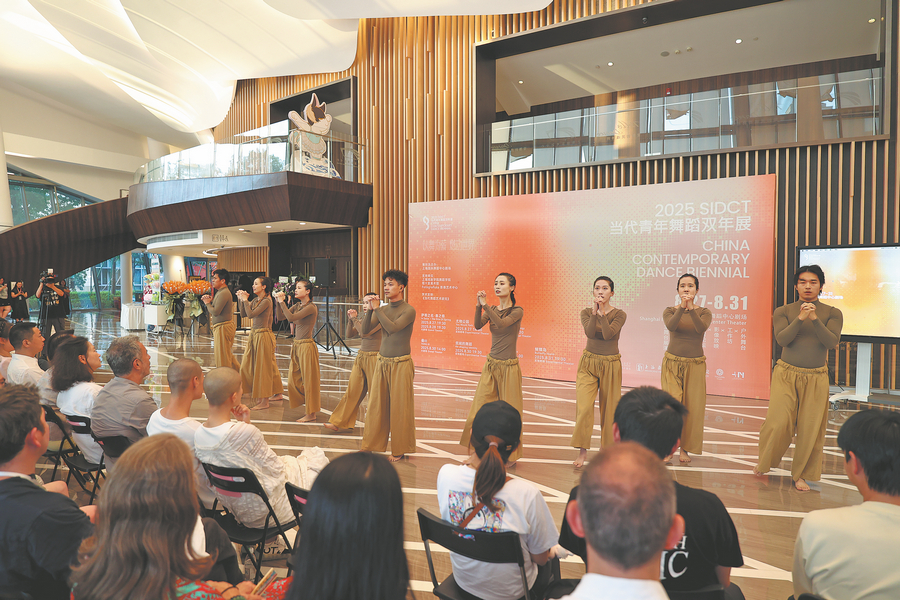
Theirs was just a 10-minute piece but performed with beautifully synchronized movements, perfect coordination and all their heart, which moved even many professionals in the audience to tears. Their performance at the opening of the 2025 China Contemporary Dance Biennial at the Shanghai International Dance Center on Aug 27 showed their four years of practice was worth it.
But what made the performance even more heartwarming is that all the dancers were deaf.
The audience, including industry leaders from 14 countries across four continents, were deeply touched by the dancers, who performed without a hearing conductor.
"I was … touched," said Bruno Heynderickx, ballet director of the Hessian State Ballet from Germany. "I almost cried because … they cannot hear the music. They are trapped in their silence, and they find unity through … dance. I think that is why I do this job. To see performances like this is really, really, really amazing."
But what the experts didn't know is that it took the Shanghai-based Walawala Deaf People's Dance Group four years to create the short piece. The greatest difficulty is that deaf dancers can't follow the beat of the music. "We tried many different measures to help the dancers get the beat," Huang Fei, choreographer of the program, said. "Sometimes one's interior rhythm is not the same as that of the music. We have to find ways to achieve a consistent interior rhythm, or we tend to dance faster and faster."
A hearing conductor standing in front of the dancers is the most convenient way to achieve that, but Huang hopes to help his dancers to "know the beat inside their heart".
"We tried to take advantage of the vibration on the dance floor, and also the stage lighting … we are still working on it, and it takes lots of practice," he said. Deaf people keenly observe things around them and are sensitive to even the slightest changes in the mood of others, which compensate for their part or complete lack of hearing, Huang said.
"That's our strength," he told the dancers during a break in a rehearsal on Sept 7. "I hope we can work together and create dance moves of your own, which speak of your ideas and your feelings. If that happens, no one else can perform those moves better than you." While Huang spoke, his wife Yu Qinxin, who is the founding director of Walawala, sat beside him translating each sentence into sign language.
"I searched about it on the web, and there are hardly any dance troupes of deaf people that can perform lots of synchronized movements without a hearing conductor," Yu said. "We hope to keep dancing together and making progress until we can create a proper dance production of maybe 50 minutes. Then we can give more public performances, be seen by more people, and claim a position for ourselves in the world of contemporary dance."
Yu has been working as a dance teacher at Shanghai Youth Technical School for the Deaf and Mute since 2012, and has headed the school's dance troupe for years.
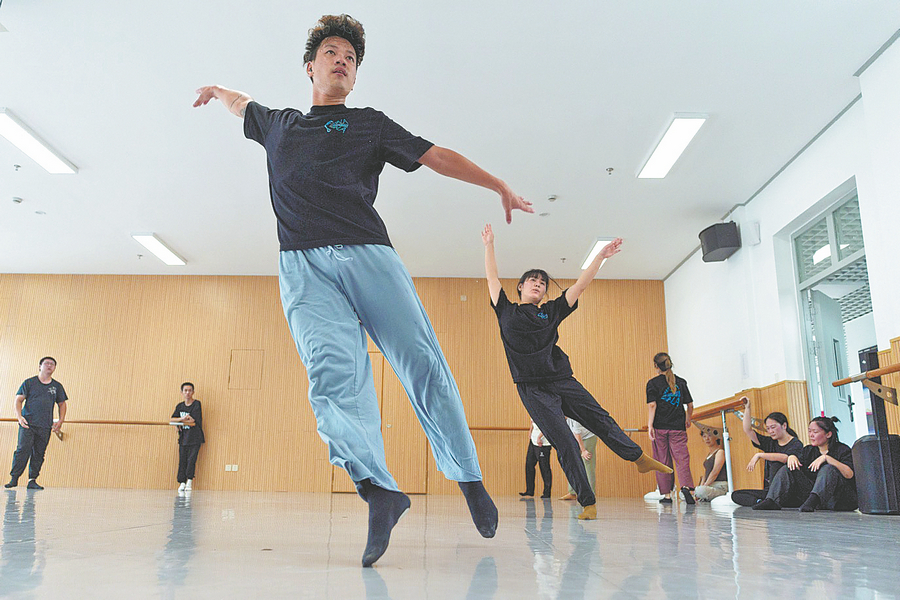
The first vocational school in China for young people with hearing impairment was founded in 1953. In 1976, one of the first dance troupes of deaf people in China was formed at the school, in order to demonstrate the artistic talents and perseverance and resilience of the hearing-impaired youth.
Dance brought them joy and confidence, and proved to the public that they are just as beautiful and vibrant as any other youth. After graduation, the students chose different career paths — while some worked in bakeries, leather workshops or other establishments, others enrolled in a university. But they missed dancing together. In 2020, Yu and more than 20 of her former students decided to form a dance troupe of their own.
Walawala is a colloquial expression in Shanghai dialect that describes the cacophony of many people talking at the same time. "They may not be able to utter much of a sound, but like other young people, they are eager to express themselves and communicate with each other … They do tell jokes, have heated discussions, and do lots of talking using sign language," she said, explaining the name of the group.
Since then, they have been meeting every week and dancing together. "Many of us are married and have kids. Sometimes, there are toddlers playing on the side while we dance in the studio," Yu said. "After all these years, we have become so close that we are like family. I am the aunt of their children, and they are the aunts and uncles for mine."
Thirty-two-year-old Wu Shenfeng is the captain of Walawala. He and his wife both dance in the troupe. During breaks in the rehearsal on Sept 7, he talked with this China Daily reporter using sign language, with Yu translating it.
"We have been dancing together for almost 10 years," he said, counting in the four years he studied at the school. "Dancing has become a natural part of my life." Wu enjoys listening to music through his hearing aid, sometimes dances to the rhythm. "I hope we could go on dancing as a group till we are old, when we could still dance together in wheelchairs."
But for 33-year-old Pan Liuzhen, dancing was not the most important reason he stayed with the troupe. "I come to dancing practice because they are here," he said, pointing at his old schoolmates sitting on the dance floor. Pan has a busy job as a graphic designer and co-coordinator of initiatives involving people living with disabilities. He tries to take part in the rehearsals as much as he can, even though he often has to work overtime on the weekend.
"We grew up together, and dancing … (helps us) rely on each other, because no one understands us like we do each other," he said.
Walawala performed its first piece, I Will be Thinking of You, at the Lantern Festival Dance Gala at Shanghai International Dance Center in 2021. The dance, a five-minute joyful recollection of school life, got Walawala onto the evening news report of China Central Television. It also won them more than 70,000 yuan ($9,839.55), which has kept the group in black till today.
"Thanks to the support of the school, which allows us to use the dance studio for free, we do not have to pay for the largest chunk of expense," Yu said. They still have some funds for group activities, and they are going to see a great contemporary dance show in November: Pina Bausch's creation of Kontakthof — Echoes of '78 at Shanghai International Dance Center.
Shanghai has about 90,000 people registered hearing impaired. They all benefit from a series of preferential policies and measures, including subsidies and discounts, for people with disabilities. The Walawala troupe members will pay half the price of the tickets for Kontakthof — Echoes of '78.





