



Young inventors redefine innovation with purpose and heart









Young Chinese inventors are actively shaping the future through innovation — among them, a team from Tsinghua University has developed a low-cost, no-flush household toilet system designed for cold and arid regions without sewer networks.
Named Pureco, the system harnesses solar or wind energy to separate waste, power lighting and heating, remove odors, and compost waste into fertilizer — ensuring sanitation without water or electricity while prioritizing user comfort.
This waterless composting toilet system offers an integrated solution balancing environmental sustainability, user-friendly design, cultural relevance and economic feasibility. Employing feces-urine separation, feces are mixed with rice husks, sawdust and probiotics, and can be fermented via manual stirring and solar heating. The stabilized compost serves as a soil amendment for farmers, and urine can be stored, aged, diluted and reused as organic fertilizer.
Data shows that as of 2022, globally 3.5 billion people still lack access to safe sanitation, and over 400 million practice open defecation. Poor sanitation causes diseases killing 800 children under five every day. In rural China, 25 percent of households still rely on unhygienic toilets — particularly in water-scarce, frozen regions where sewer systems are costly, according to the team.
Over the past decade, the team has made inspection tours to 64 villages in over 20 provinces across China, with their invention benefiting nearly 9,000 households by May. Particularly tailored to rural households in challenging climates, it has greatly improved public health and generated environmental outcomes.
"Compared to traditional pit latrines, it requires less frequent cleaning and lower costs, which significantly increase farmers' willingness to adopt improved sanitation. And it's not just for rural China, it can also serve communities in rural areas across Asia and Africa that still lack proper toilets … This market has huge potential," says Liang Ji, a team member and PhD student from the Eco-Design Research Institute of the Academy of Arts and Design at Tsinghua University.
The design is also China's national winner of the 2025 James Dyson Award, an international design award that celebrates, encourages and inspires the next generation of design engineers. Since the award's introduction to China in 2016, it has inspired over 20,000 Chinese university students to participate, receiving more than 3,500 original design submissions.
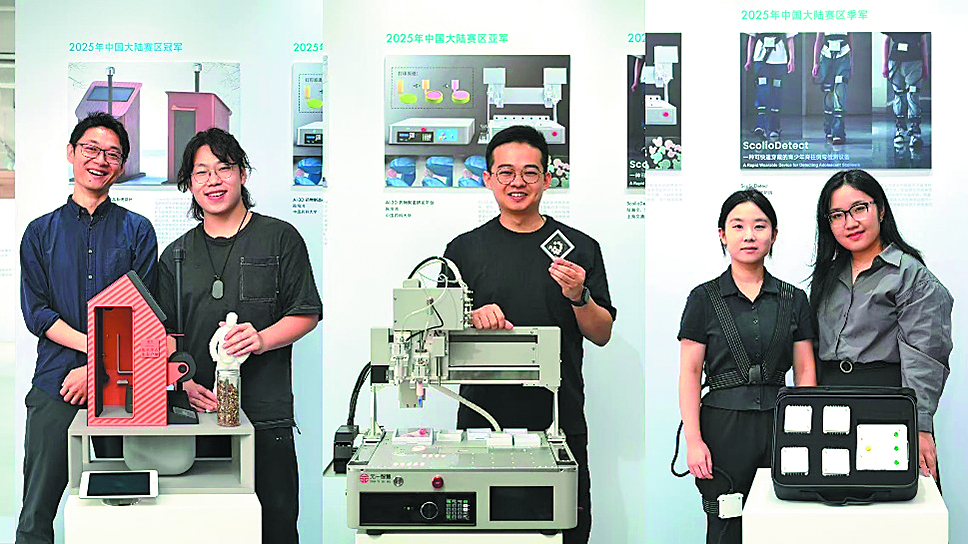
The top three China finalists for the 2025 James Dyson Award, an international award that celebrates, encourages and inspires the next generation of design engineers. CHINA DAILY
The national runner-up is an AI-driven integrated pharmaceutical 3D system created by Chen Peihong, a PhD student from China Pharmaceutical University. It enables on-demand production of personalized medications in compact, compliant workshops — offering precise, flexible treatment for vulnerable and remote populations.
The other national finalist is the ScolioDetect, developed by Lu Hanwen and Song Xinyuan from Shanghai Jiao Tong University, a wearable sensor system that translates natural walking patterns into spinal curve data. With a three-degree margin of accuracy, it enables radiation-free scoliosis detection in schools and communities.
"It just takes three minutes from wearing (the device) to receiving a report, much faster than X-rays. X-rays require large machines and hospital settings, making them unsuitable for screening scenarios. Our device is specifically designed for rapid early detection in screening contexts," says Lu, a postgraduate student from the School of Design at Shanghai Jiao Tong University.
Over the past decade, entries in the Dyson Award's China chapter have spanned healthcare, agriculture, environmental ecology, public health, sustainability, and disaster relief. Many winning designs have since entered real-world use, improving daily life.
Hu Hongfei, head of electronics at Dyson, and a five-time judge of the award, has witnessed successive groups of future inventors tackling real-world challenges through innovation.
He points out that this year's top three teams in China not only showcased their engineering talent, but also highlighted their social responsibility and human-centered problem-solving perspective.
"Their actions demonstrate that true invention stems from keen observation of the real world and the resolve to solve problems through technological innovation. This embodies the very essence of the inventor's spirit," says Hu.
Wu Wanzhen contributed to this story.


- Increase in western Pacific military activities noted
- China, Pakistan pledge deeper military ties
- SPP to oversee handling of Shanxi mine explosion case
- Mine blast victims get mental health counseling
- China leads with ‘deep and real’ methane control efforts, expert says
- China calls for fair global ocean governance in Xiamen symposium





