


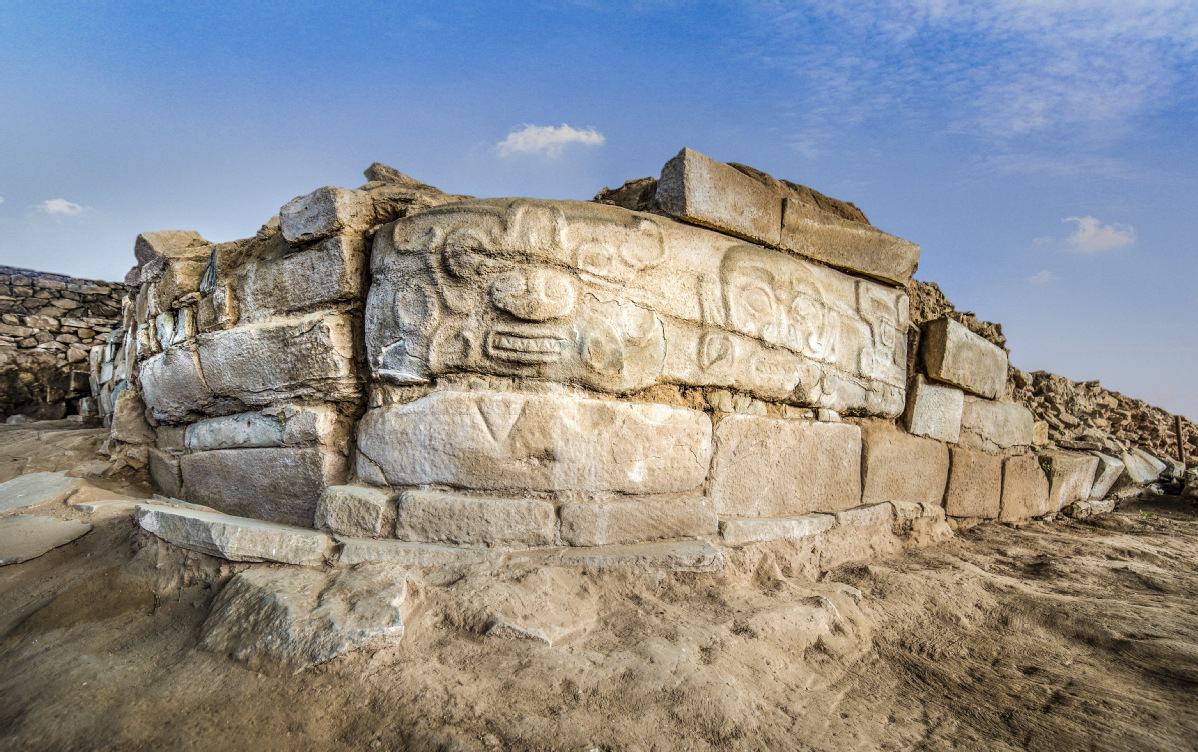
A 13-year study of DNA samples collected from the 4,000-year-old Shimao site, a complex of gigantic prehistoric ruins on the northern edges of the Loess Plateau in Shaanxi province, has unlocked clues that could decode the population structure and kinship systems of the ancient people who inhabited the area.
According to the study published in the journal Nature on Thursday, analyses of DNA samples collected from 169 human remains excavated from and near the Shimao site in Shenmu, Shaanxi, make researchers believe that this cyclopean city, inhabited from around 2300 to 1800 BC, was built by "locals". The Shimao people predominantly descended from groups that had lived in the region for roughly 1,000 years before them.
Further analysis revealed cultural and genetic connections between the Shimao people and the Yangshao culture, an iconic Neolithic civilization dating back 7,000 years that thrived along the Yellow River and whose discovery in the 1920s marked the birth of modern Chinese archaeology.
All extraction, sequencing and data processing of ancient human samples were carried out in the laboratories of the Chinese Academy of Sciences' Institute of Vertebrate Paleontology and Paleoanthropology in Beijing."It clearly showed a genetic and cultural continuity," said Fu Qiaomei, deputy director of the institute and leader of the research, at a news conference on Thursday in Beijing, while elaborating on the study.
"We also found a dynamic picture that diverse groups of people got mixed," Fu said. "It showed Shimao was probably more than just a political and military center of the region. It could be a hub of massive, trans-regional cultural exchanges and trade."
For example, researchers found close genetic and cultural connections between the Shimao people and populations associated with the Taosi site in Shanxi province, steppe populations to the north, and rice-farming communities to the south, suggesting extensive interactions and exchanges among prehistoric farming and pastoral cultures.
"It demonstrated an inclusive nature of Chinese civilization even in its early stage," Fu added.
Spread over 4 square kilometers, the walled Shimao site is the largest prehistoric settlement ever discovered in China. The culture cast its influence on a wide area covering over 200,000 sq kilometers.
The unconventional stone structures and wall — most prehistoric settlements in China were built with rammed earth — once made people believe it was a part of the nearby Great Wall, which in reality was actually a millennia younger.
The site's importance in the study of the origins of Chinese civilization emerged after major archaeological research began there in 2012, and soon attracted global attention. In 2021, Shimao was listed by the Archaeological Institute of America as among the world's top 10 discoveries of the decade.
The site can be divided into outer and inner enclosures, showing features typical of structured societies. There is evidence of sophisticated craft production like jade processing, construction of large fortifications and high social stratification, revealed through cemeteries and human sacrifices.
"The massive structure at the heart of the site bears features of 'a palatial city'," Shao Jing, deputy director of the Shaanxi Academy of Archaeology, said at the news conference.
"In recent years, we also found a large cemetery, an area that was thought to be used for sacrificial ceremonies, and roads," he said."The site creates a benchmark for studies of early-stage palaces in the region."
However, the origin of the founding populations of Shimao and other Loess Plateau settlements as well as their interactions are yet to be determined. Conducting large-scale and complicated genetic studies focusing on a prehistoric "capital-level" city is still rare in the world.
Around 80 human skulls were found at the east gate of the city. No other archaeological site in China has revealed such a large number of human skulls until those from the late Shang Dynasty (c.16th century-11th century BC).
Genetic evidence now shows that nine out of 10 buried at the site were male. As male sacrifices were concentrated at the east gate and female sacrificial remains were associated with elite cemeteries, researchers said this suggested Shimao's sacrificial practices were highly structured and gender-specific roles were tied to distinct ritual purposes.
The study's genetic analysis also reconstructed family pedigrees spanning up to four generations within Shimao society, uncovering a social hierarchy organized around patrilineal descent.
"These findings transform Shimao from a grand physical heritage into a vivid entity reflecting social life," Fu from the Institute of Vertebrate Paleontology and Paleoanthropology said.
The site thus provides an unprecedented micro perspective and model for understanding the power structure and social organization patterns of early Eastern Asian states, she added.





