



China taps high-altitude wind energy niche









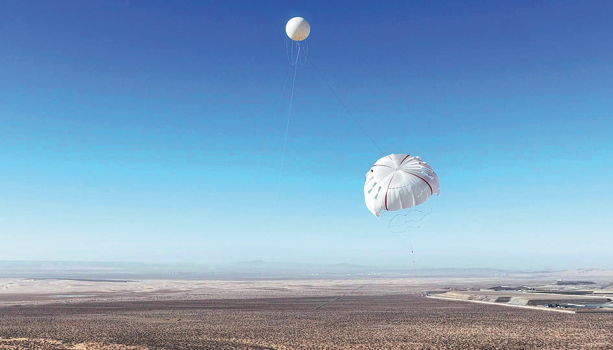
China has successfully deployed the world's largest high-altitude wind energy collector, a giant 5,000-square-meter kite or "wind-catching sail", marking a crucial step in the nation's cutting-edge exploration of renewable energy from high-altitude winds.
The successful trial, conducted last month at an experimental field in the Inner Mongolia autonomous region, validates a core component of China's first national key research and development plan for high-altitude wind energy, said its operator China Energy Engineering Co Ltd.
The breakthrough is set to open a completely new domain for new energy development in China, CEEC said.
According to the company, the colossal device works by harnessing the powerful, stable and high-velocity winds found at altitudes above 300 meters.
During the test, a helium balloon, 17 meters in diameter, slowly ascended, towing the enormous 5,000-square-meter sail into the sky where it unfurled. Once airborne, the sail captures the kinetic energy of the wind, transmitting a powerful pulling force down a tether cable to a specialized ground-based generator, which converts the motion into electricity.
The project provides the scientific basis for finalizing the design of the kite-ladder system. Every data set is the cornerstone for the future full set of equipment and standards, it said.
The experiment also successfully tested the deployment and retrieval of smaller, dual 1,200-square-meter work sails, further demonstrating the system's operational flexibility, it added.
Industry experts believe high-altitude wind energy represents a major, yet largely untapped, frontier in renewable power generation.
High-altitude wind energy is considered an untapped frontier in renewables that holds significant potential to supplement traditional wind power, known for its consistency, high wind speed and immense energy density, said Lin Boqiang, head of the China Institute for Studies in Energy Policy at Xiamen University.
This resource holds significant potential to supplement traditional power sources and grid operations, providing a more stable and predictable clean energy input, he said.
Furthermore, by utilizing lightweight materials for the harvesting units and requiring minimal use of heavy components like steel and concrete, the cost of these airborne systems can be kept low, dramatically reducing the levelized cost of energy compared to conventional wind farms, he added.
According to studies published in 2009 and 2012 by researchers with the Washington-based Carnegie Institution for Science, the theoretical potential of wind energy found at high altitudes is immense.
Current global research is focused on two main technological routes: airborne systems, where lightweight turbines fly to generate power in the air, and the ground-based approach tested here. The ground-based system uses the airborne sails to capture wind and generate power via a system on the ground.
Huo Shaolei, a senior technical expert at CEEC, highlighted the validation of the technology's scalability.
The successful deployment of the ultra-large work sail proves the feasibility of the kite-ladder-type ground-based high-altitude wind power generation technology to achieve large capacity and high-power output, he said.
According to the company, the sail deployed, at 5,000 square meters, is roughly the size of 12 standard basketball courts. The system is designed to operate at capture heights of up to 5,000 meters or even 10,000 meters — a massive vertical range equivalent to stacking dozens of conventional wind turbines.
The technology boasts significant economic and environmental advantages over traditional onshore wind farms, as high-altitude wind power systems are expected to save 95 percent of land use and reduce steel consumption by 90 percent, leading to a potential 30 percent reduction in the cost of electricity per kilowatt-hour.
Just a single 10-megawatt high-altitude wind energy system is estimated to generate 20 million kWh annually, enough to power 10,000 homes for a year, it said.
CEEC has announced plans to move forward with multi-kite flight testing and aims to enter the full power generation experiment phase by the end of next year.


Today's Top News
- Global economic growth to slow to 2.8% in 2026: OECD
- Mainland warns DPP authorities of consequences for selling out national interests
- Fujian to host 18th Straits Forum
- Innovation fuels investor trust in Asia-Pacific
- Japan's remilitarization slammed
- Chinese aerospace leaders engage industrial thrust





