


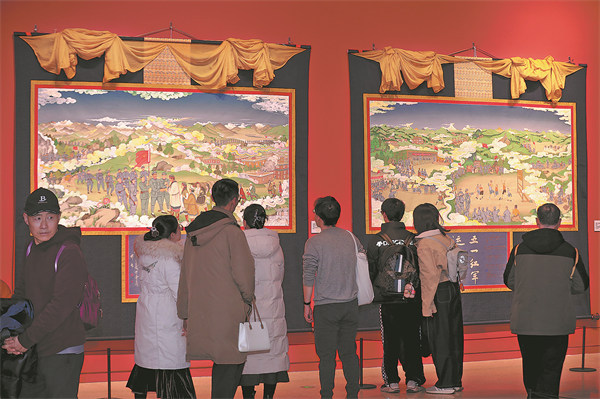
The school traces its origins to the 17th-century master Langkajie, whose name means "a venerable painter who decorates the sky". A distinction from other thangka styles that emphasize yellow hues, Langkajie's approach features soft pastels like light purples and pinks, creating a serene, ethereal quality.
His works masterfully employ perspective, with clear foreground objects and softer backgrounds. This artistic legacy has now been passed down to an 11th generation of inheritors.
Among them is painter Tse-ring Norbu, who began learning thangka at age 7 and has studied under Langkajie lineage holders for three decades. "The Langkajie school teaches one of the few thangka traditions that combines Western oil painting techniques with the meticulous brushwork of Eastern gongbi-style (meticulous painting) painting," he explains.
Tse-ring Norbu contributed to several major historical works in the exhibition. To accurately depict the Red Army's local life, he conducted extensive fieldwork, listening to elders' recollections and consulting historical archives. "Using thangka to portray these themes expands the vitality of traditional skills and represents an active practice of engaging with contemporary narratives through intangible cultural heritage," he says.
"Innovation does not mean abandoning tradition, but rather creating a dialogue between ancient craftsmanship and modern values."
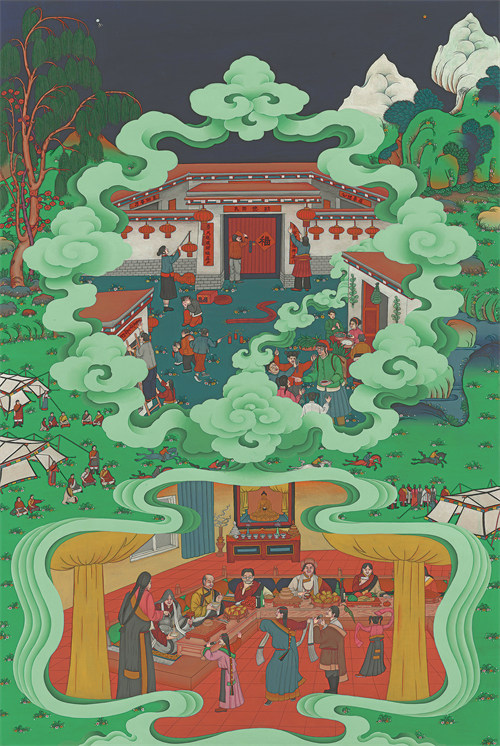
He emphasizes that documenting history through thangka is not merely about illustrating scenes; it requires creatively integrating the school's unique features. For instance, he uses meticulous brushwork to depict the muscular lines of warhorses and the determined expressions of soldiers, while layered mineral pigments re-create the light and shadow of the plateau spring.
"Technique only truly touches hearts when it integrates the emotions and memories of our time," says Tse-ring Norbu. "We will continue to innovate, making Langkajie thangka a colorful brush connecting history and the future."





