


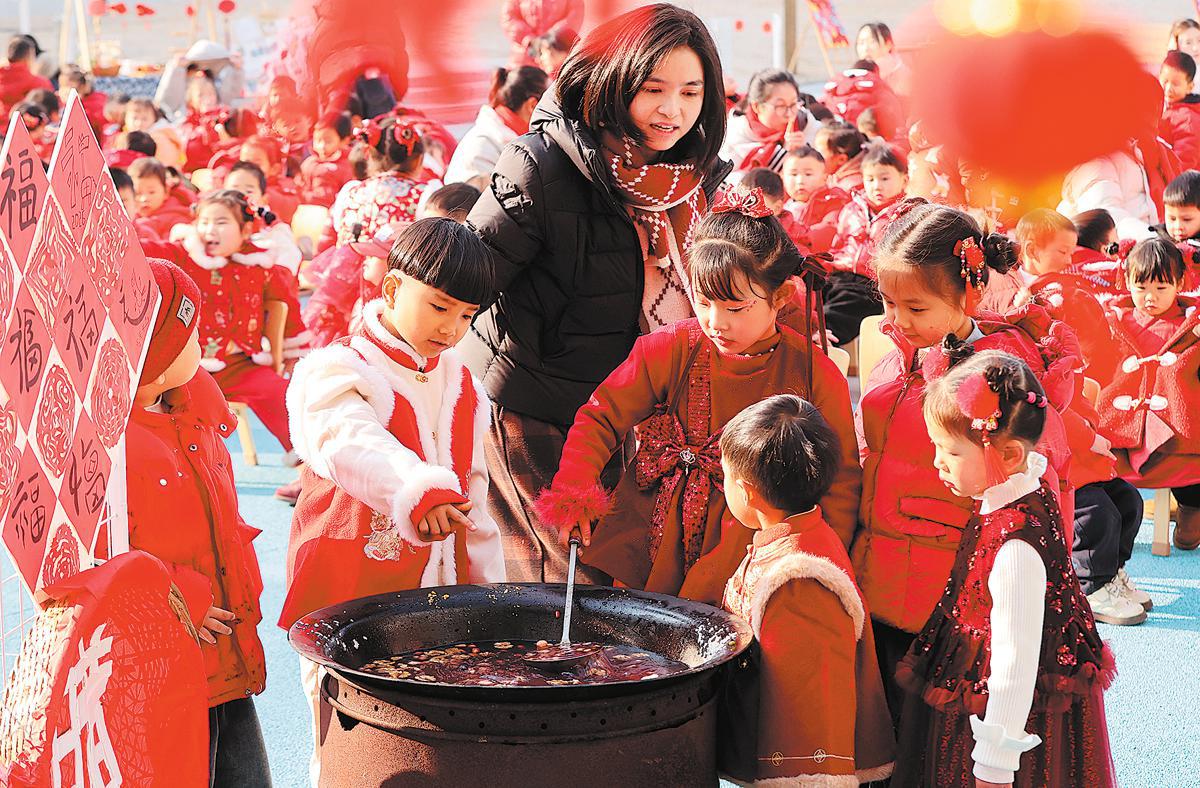
On the eighth day of the 12th month on the Chinese calendar, which falls on Monday this year, the aroma of laba porridge will drift across Beijing and the rest of the country, signaling the arrival of the Chinese New Year season.
The character "la" refers to the 12th month on the Chinese calendar, while "ba" means the number eight. For most people, savoring labaporridge — which is typically made of at least eight ingredients including glutinous rice and red beans — is more than a traditional ritual, because it marks the moment when the year-end countdown starts and serves as the prelude to new beginnings.
Despite the cold spell in the Chinese capital, warmth will fill the halls of its historical temples on Monday. Yonghegong, also known as Lama Temple, a magnificent testament to Beijing's rich culture and spiritual heritage, will launch its annual laba porridge distribution, as will Guanghua, Tanzhe and other temples, drawing large crowds of visitors.
Temple-based porridge distribution remains central to the laba tradition in Beijing, with Yonghegong being the most anticipated site. Bowl after bowl of steaming hot porridge there is not only expected to help buffer the winter chill, but also provides people with a shared sense of hope.
Since the Qing Dynasty (1644-1911), laba porridge prepared at the temple has been one of the city's most significant seasonal events. From emperors to ordinary residents, everyone believed — and still believes — that partaking of a bowl of the temple's porridge brings good fortune and peace in the year ahead.
Historical records show that Emperor Yongzheng attached particular importance to the laba ceremony, elevating it to a rigorously regulated imperial ritual. Preparations began as early as the first day of the 12th month of the Chinese calendar and continued for eight days.
According to Qing Dynasty archives, a single ceremony required more than 720 kilograms of primary ingredients, with the total weight of all ingredients reaching 1,000 kg. About 5,000 kg of firewood was used to prepare laba porridge, reflecting the scale and solemnity of the event.
Visitors to Lama Temple today can still see the massive copper cauldron once used exclusively for making laba porridge. Crafted by the erstwhile imperial workshop, the vessel measures about two meters in diameter and 1.5 meters in depth, and weighs around 8 metric tons.
Originally placed near the temple's eastern gate, the cauldron stood over a deep earthen stove supported by iron pillars to ensure steady heat, offering a glimpse into the grandeur of past ceremonies.
Traditionally, laba porridge at Lama Temple was made in the same pot six times, with each preparation serving a distinct purpose. The first pot was offered to the statues of Buddha, including those in the Forbidden City and imperial gardens. The second was presented to the imperial family, enriched with cream and preserved fruit to reflect royal refinement.
Subsequent pots were distributed among senior officials and monks, while the sixth one was shared with members of the public, embodying the ideal of celebrating together with the people.
The ingredients reflected imperial standards. For example, during Emperor Qianlong's reign, laba porridge was made of 13 ingredients, including millet, rice, beans, red dates, chestnuts, almonds and brown sugar.
Other ancient shrines in Beijing have their own laba rituals. The Guangji and Guanghua temples begin distributing the porridge before dawn, with residents lining up in the dark to be among the first to receive a bowl. Tanzhe Temple, which boasts a history of more than 1,700 years, offers what many longtime Beijing residents regard as "a symbol of peace and good health".
Beyond temples, the laba tradition also finds expression in everyday urban life. Huguosi Snack, a well-known eatery in the Chinese capital, recently launched a laba porridge variety on its menu, featuring more than 20 ingredients.
Aoliao Jiaxin, a user on social media platform Xiaohongshu, or RedNote, said she tried the porridge at Huguosi on the first day and found it "packed with real ingredients and very satisfying".
Across China, regional variations lend laba porridge distinct local character. Northern versions tend to be thick and hearty, often paired with pickled laba garlic. The porridge in Jiangnan, or the southern region in the lower reaches of the Yangtze River, is lighter and delicately sweet, with some prepared in savory form. In the northwest, lamb is a key ingredient for extra warmth.
Yet everywhere, laba porridge emphasizes harmony, with the blend of grains symbolizing abundance and envisaging a prosperous year ahead.





