BEIJING - China has accumulated the world's largest holding of foreign exchange reserves on the back of trade booms and cash inflows. But the era of rocketing growth may be drawing to an end.
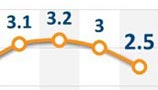
The People's Bank of China, or the central bank, said Thursday that the nation's foreign exchange reserves had hit $3.31 trillion by the end of 2012, ensuring the fund kept its place as the world'd biggest of its kind. But the annual increase in 2012 was only about $130 billion, the smallest since 2004.
Surging exports and consistent inflow of foreign investment have driven China's foreign reserves on the fast lane in the past decade. China overtook Japan as the world's largest holder in 2006, and its annual increase hit a record high of $460 billion in 2007. However, the growth rate has sharply slowed since last year.
The slowdown was due to the country's more balanced trade, said Lian Ping, chief economist of the Bank of Communications. China's current account surplus accounted for 10 percent of its Gross Domestic Product in 2007. Last year, the proportion fell to less than three percent, he noted.
The slowing trade surplus and the changing expectations for the yuan's exchange rates amid a fluctuating global financial situation explain China's slowing foreign reserves, Lian said.
While its growth rate is slowing, China's trade surplus registered an increase of 48.1 percent in 2012 from the same period a year before, according to an announcement by the General Administration of Customs on Thursday.
With the trade surplus and net inflow of Foreign Direct Investment still big, the foreign reserves increased only $130 billion, which indicate the capital and financial account has cash outflows, said Liu Dongliang, a senior researcher with the China Merchants Bank.
According to the State Administration of Foreign Exchange, China's capital and financial account accumulated $85.4 billion of deficit in the first three quarters of 2012, compared with a surplus of $234.1 billion in the same period a year earlier.
Analysts said corporate and individuals' growing overseas investment also contribute to the slowing reserves.
According to the SAFE, China's non-financial sector invested $52.5 billion in overseas assets in the first three quarters of 2012, an increase of 29 percent year-on-year.
Zhao Qingming, a China Construction Bank economist, said the slowdown in its foreign reserves is entirely expected by China, that it lessens pressure for the yuan's appreciation and is significant for maintaining stable exchange rates.
Liu Dongliang added that the fast growth of foreign exchange reserves has drawn to an end. The economist predicted slow growth alternating with mild contraction for the future.


Copyright 1995 - . All rights reserved. The content (including but not limited to text, photo, multimedia information, etc) published in this site belongs to China Daily Information Co (CDIC). Without written authorization from CDIC, such content shall not be republished or used in any form. Note: Browsers with 1024*768 or higher resolution are suggested for this site.
License for publishing multimedia online 0108263 Registration Number: 130349