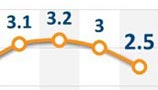
As tapering of QE will tighten liquidity and raise the cost of funds, Asia's emerging markets with twin deficits - India, Indonesia, Thailand, Pakistan and Sri Lanka - could be the most challenged from the prospect of higher borrowing costs. Those that have a higher percentage of foreign investors in their capital markets - Malaysia, Indonesia, Thailand and the Republic of Korea - will be more vulnerable to a sudden change in portfolio fund flows, raising risks to financial stability in terms of exchange rate and interest rate volatility.
Since consistent policy and clear market communication is essential, domestic capital markets that can efficiently intermediate between domestic savings and investment needs will play an even more significant role. Therefore, steps to improve transparency and good governance will be essential to enhance investors' confidence.
|
 |
|
 |
Abundant global liquidity has led to a build-up of private debt in Asia's emerging markets. Rapid credit growth was observed in several emerging markets in Asia in the past few years. In 2013, several economies, including Singapore, China, the Philippines and Indonesia, saw double-digit credit growth. Household debt as a percentage of GDP increased substantially between 2009 and 2013, especially in Indonesia, China, Thailand and Malaysia. True, the ROK and Singapore did not see a large increase, but the two economies already had a high level of household debt, with ratios of household debt to GDP being above 70 percent.
The eventual rise in domestic interest rates could potentially challenge the repayment capacity of some borrowers and consequently lead to an increase in non-performing loans and a decline in profitability in the domestic banking sector.
And closely related to credit growth is the rapid rise in asset prices during the QE years. Property markets have risen sharply in many emerging economies in Asia despite several rounds of price-curbing measures. Tapering-induced consolidation and correction of property prices will pose challenges to the banking sector with large exposure to property-related loans, including those in Hong Kong and Singapore. But prudential measures have been in place in many countries and regions to mitigate risks of a property market correction, thus Asia's emerging economies should be able to avoid a major crisis, similar to the sub-prime meltdown in the US.
As the "taper tantrum" episode shows, investors do distinguish between emerging markets that embrace reform and those slower to do so. Fed tightening has preceded a few emerging market crises in the past. Emerging markets in Asia should therefore not be complacent.
The author is a Deutsche Bank Economist for the Asia-Pacific region. The views expressed are those of the author and do not necessarily reflect the official views of Deutsche Bank or its related entities.

Copyright 1995 - . All rights reserved. The content (including but not limited to text, photo, multimedia information, etc) published in this site belongs to China Daily Information Co (CDIC). Without written authorization from CDIC, such content shall not be republished or used in any form. Note: Browsers with 1024*768 or higher resolution are suggested for this site.
License for publishing multimedia online 0108263 Registration Number: 20100000002731