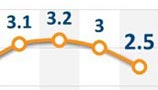
The first half of 2014 has ended with China's growth momentum seemingly rebounding after a very weak first quarter. Government mini-stimulus measures have helped support growth, and exports seem to be recovering. We estimate that quarter-on-quarter GDP growth increased about 7 percent in Q2 and see it rising to 8 percent in Q3.
However, in the face of persistent property market weakness and increasing financial difficulties in parts of the economy, growth momentum looks set to slow in Q4 2014 and into next year. We expect GDP growth to slow to 6.8 percent in 2015 with the government's policy support offsetting most of the negative drag from the property downturn, but see a 15 percent risk of growth slowing to above 5 percent.
The government is well aware of the sustainability uncertainty over China's current pace of growth, and is worried about the ongoing property downturn. Senior leadership has stated that maintaining growth is still very important, but they have also said they do not want to use strong stimulus measures and revert back to their "old tricks" of relying upon easy money conditions and/or another property bubble.
So what more can the government do to support growth and prevent a hard landing in the coming months and year?
We expect the government to continue to raise infrastructure and public service investment, accelerate reforms to facilitate corporate and private sector investment as well as household consumption, maintain a relatively accommodating monetary and credit policy stance, and keep the Chinese yuan from further appreciation against the US dollar. The latter two are helped by the absence of inflationary pressures (we expect CPI inflation to average 2.4 percent in 2014, down from the previously expected 2.7 percent).
The government so far remains reluctant to ease property policies significantly. Allowing a serious adjustment in property and related heavy industrial sectors alongside a cleanup of the financial sector may be good for China's long term economic health, but the adjustment could be very painful in the short term. Therefore, it remains to be seen how weak a level of growth the government can tolerate, especially if the current intensity of policy support turns out to be insufficient.
We still anticipate meaningful progress in financial sector reforms this coming year, with measures to lower corporate funding costs and financial risks being adopted as ongoing interest rate liberalization and capital account openings further progress.
The article is coauthored by UBS economists Wang Tao, Donna Kwok, Harrison Hu, and Ning Zhang. The views do not necessarily reflect those of China Daily.

Copyright 1995 - . All rights reserved. The content (including but not limited to text, photo, multimedia information, etc) published in this site belongs to China Daily Information Co (CDIC). Without written authorization from CDIC, such content shall not be republished or used in any form. Note: Browsers with 1024*768 or higher resolution are suggested for this site.
License for publishing multimedia online 0108263 Registration Number: 20100000002731