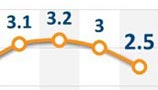
BEIJING -- China may further lower its economic growth target for 2015 during the upcoming legislative session, foreign and domestic experts predict.
The annual meeting of the National People's Congress, China's top legislature, starts this week alongside the meeting of the National Committee of the Chinese People's Political Consultative Conference, the top political advisory body.
As in previous years, China's premier is expected to deliver a government work report that will set the annual growth target.
Last year's target was "around 7.5 percent", but the economy narrowly missed it after registering a 24-year low of 7.4 percent year on year.
The last time China lowered its growth target was in 2012, when the target of 8 percent, which had been the same for 7 years, was cut by half a percentage point.
Economic indicators for the beginning of 2015 are disappointing, in January factory activity slumped below the boom-bust line for the first time in more than two years, consumer prices dropped to 5 year low and trade sank below expectations, fueling anxiety and feeding speculation about whether the government will lower its growth target.
While it is inherently risky to foretell such an important decision, economists seem confident China will, again, lower its growth target.
The Chinese leadership have implied that a lower expansion rate, for example 7 percent, would be acceptable.
"Even a growth rate of around 7 percent would place the Chinese economy among the top in the world for both speed and volume," President Xi Jinping told the Asia-Pacific Economic Cooperation (APEC) CEO Summit in November last year.
Wang Xiaoguang, a researcher with the Chinese Academy of Governance, said that while the setting of a specific target remained unclear, it was likely to be around 7 percent, should the government decide to set one.
Barclays economists wrote in a research note last week that they expected the government to lower its growth and inflation targets to around 7 percent and 3 percent, respectively, for 2015, from 7.5 percent and 3.5 percent in 2014.
Less optimistic observers include the International Monetary Fund (IMF), which recently lowered its China growth forecast to 6.8 percent for 2015 and to 6.3 percent for 2016.
Justin Yifu Lin, former chief economist and senior vice president of the World Bank, however, maintained in January that China would be able to have between 7 to 7.5 percent growth rate for another 10 to 15 years.
Bloomberg economists said last Friday that the number "could be lowered to 7 percent, or -- more speculatively -- even abolished entirely in favor of a forecast range".
The events are being closely watched around the globe, as many believe the growth target is not only the official barometer of China's economics, but also sheds further light on how the Chinese leadership plan to steer the economy. With a gross domestic product (GDP) of $10.37 trillion in 2014, China is second only to that of the United States.
On the one hand, growth of less than 7.5 percent is widely acknowledged as enough to propel China on the path toward its long-term development goals.
The country has promised to double GDP achieved in 2010 by 2020, to achieve this a year-on-year expansion rate of 6.8 percent from 2014 through 2020 would be sufficient, according to Lin's calculations.
Another significant task for the Chinese leadership is job creation. Should the government maintain its employment target of creating 10 million new jobs each year, Barclays said, then "1 percent of GDP growth, which creates around 1.5 million jobs, suggests a lower growth rate of 6.0-6.5 percent is sufficient".
A growth rate of 7 percent would be enough to meet expected job creation targets, wrote Li Wei, Director of the Development Research Center (DRC) of the State Council, last year.
On the other hand, as repeatedly stressed by the leadership, China has entered a "new normal" phase, characterized by middle-and-high-speed growth, instead of the break neck expansions of previous years.
The priority, thus, is not "at-all-cost growth" but structural reform measures to address systematic imperfections, to produce long term benefits.
More fundamental measures are also eagerly expected.
"The NPC will also signpost priorities on the long-term reform agenda," wrote Bloomberg economists, which include state-owned enterprises and financing.
"Whatever the target does or does not present, the leadership is aware of the odds," said Wang Xiaoguang.

Copyright 1995 - . All rights reserved. The content (including but not limited to text, photo, multimedia information, etc) published in this site belongs to China Daily Information Co (CDIC). Without written authorization from CDIC, such content shall not be republished or used in any form. Note: Browsers with 1024*768 or higher resolution are suggested for this site.
License for publishing multimedia online 0108263 Registration Number: 130349