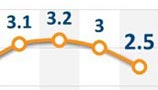
The government is likely to retain its focus on enhancing the implementation of and funding for infrastructure investment, especially in light of the negative impact to come from recent stock market volatility which will lead to a less strong financial services performance in H2. It will be at the cost of rolling back some fiscal reforms and with the help of accommodative monetary and credit policies.
Recent compromises made in fiscal reform will likely be sustained, including leniency on LGFV borrowing. Pro-growth structural reforms such as red-tape/approvals reduction, more social welfare provisions, and hukou reform in lower tier cities will be pushed forward as well to encourage corporate/private sector investment and household consumption. Should property sales take a stumble again later, additional property policy easing is possible - for example, cutting first home mortgage down payment from current 30 percent to 20 percent) – though we do not think this is imminently needed.
The recent equity market turmoil will likely result in a strengthening of government financial regulations and supervision, especially over margin financing. The recent suspension of IPOs may also impede near-term capital raising and M&A activity, delaying some SOE equity incentive plans/mixed ownership reform plans.
The government may take a more cautious approach to China's ongoing capital account opening, but we expect further progress still to come. The broad opening of domestic interbank market to foreign central banks, sovereign wealth funds and international organizations announced on July 14 is an example.
The central bank (PBOC) will likely continue to keep the RMB stable and reasonably strong against the USD to help progress the RMB's internationalization, and to avoid destabilizing expectations on the exchange rate.
H2 growth outlook still challenging
While we expect sequential improvement to continue in Q3, helped by stronger infrastructure support and a modest export recovery, we think the impact of policy support will start to fade in Q4 whereas the negative knock-on impact from ongoing property construction downshift will continue unabated. While the recent property sales recovery will likely mean less bad construction growth in the rest of this year and lower risk of a property-led hard landing, the risk to our forecast remains biased somewhat more to the downside.
In addition to the negative impact likely coming from less active equity market and lower contribution hard landing, the risk to our forecast remains biased somewhat more to the downside.
In addition to the negative impact likely coming from less active equity market and lower contribution from financial services, the bigger downside risk will likely come from weaker-than-envisaged construction activity and bigger knock-on effect for the rest of the economy, as excess capacity may take longer to be resolved.
Another risk would be the degree and length to which the government can further increase infrastructure investment beyond the next few months. On the external side, global demand outside of the US looks fragile, and the past appreciation of the RMB has made Chinese exports less competitive than previously, both of which could mean an additional downside risk.
As such, we expect GDP growth to stabilize in sequential terms in Q3 but fade in Q4, and see year-on-year growth decelerating in second half. We maintain our 2015 GDP growth forecast of 6.8 percent.
The article is written by UBS economists led by Wang Tao. The views do not necessarily reflect those of China Daily.

Copyright 1995 - . All rights reserved. The content (including but not limited to text, photo, multimedia information, etc) published in this site belongs to China Daily Information Co (CDIC). Without written authorization from CDIC, such content shall not be republished or used in any form. Note: Browsers with 1024*768 or higher resolution are suggested for this site.
License for publishing multimedia online 0108263 Registration Number: 130349