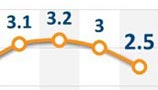
Despite the flat GDP growth seen in the second quarter, there was a visible improvement in the overall economy, especially at local levels.
As of Wednesday, 23 regional governments have released their GDP data for the first half of 2015. Twenty-one regions reported faster growth in the first half compared with the first quarter.
Anhui and Shandong provinces maintained flat growth in the first quarter, China Daily's compilation of each region's statistics bureau data showed.
The fastest regional expansion was 11 percent, which occurred in the southwestern metropolis of Chongqing, followed by a 10.7 percent growth in Guizhou province. The slowest expansion was seen in Hebei province. But even the 6.6 percent advance in the country's steel and iron hub was an improvement over the 6.2 percent recorded in the first quarter.
Hainan province grew 7.6 percent in the first half, 2.9 percentage points higher than that of the first quarter, so far the largest among all regions. The Xinjiang Uygur autonomous region also saw its growth enhanced, from 6.9 percent to 8.2 percent.
Economic powerhouse Guangdong province grew 7.7 percent, up from 7.2 percent in the first quarter, while Zhejiang province grew 8.3 percent, up from 8.2 percent.
The nation's GDP expanded 7 percent year-on-year in the second quarter, earlier data from the National Bureau of Statistics showed. So far only Hebei's growth is below that level.
The improved growth could be attributed to a recovery in the real estate market and the steady acceleration of the service sector. For example, in the tourism and property-reliant Hainan province, year-on-year decline of the residential sale value in the first half narrowed by a whopping 21.8 percentage points compared with that of the first quarter, which explained why its service sector grew 9.3 percent in the first half, up 5 percentage points from that of the first quarter.
The bull run in the equity market of the first half of the year also brought huge benefits to the financial sector. In Shanghai, value added from the sector soared 30.1 percent over a year ago, while in Guangdong it increased 23 percent.
The boom in the financial and property sectors, however, has alerted some economists, particularly putting it in the context of persistent weakness in the real economy.
Wang Jie, a spokesman for Zhejiang's statistics bureau, said the province should not indulge in the 8.3 percent growth in the first half.
"A stable and healthy economy requires a stable financial, securities and capital market. Rapid growth in real estate investment should also be avoided to prevent the spread of imbalances," he said.
Chen Yao, secretary-general of the Chinese Association for Regional Economics, warned that Hainan's heavy reliance on the property industry is unsustainable. To further develop, it should strive for the higher-end service sector.
Growth is not necessarily all good across China. The hardest-hit northeastern region, as well as Shanxi province, are yet to disclose their performance data. President Xi Jinping's visit to the heartland of Northeast China, especially State-owned enterprises there last week, underscored the immense downward pressure.
Liaoning province in the region saw its GDP growth slump by 3.9 percentage points to 1.9 percent in the first quarter, the lowest nationwide.
Industries still under 'considerable' pressure
The industrial sector still faces "considerable downward pressure" and some industries are facing "increasing difficulties", the Ministry of Industry and Information Technology said on Wednesday.
"Some regions, industries and businesses are facing increasing difficulties, and strong efforts are needed to stabilize and improve the industrial operations," Zhang Feng, a spokesman for the ministry, told a news conference.
The comments are in contrast to the general improvement in the industrial sector, and could signal the concerns faced by policymakers for the remainder of the year, analysts said.
China's industrial output gradually recovered from 5.6 percent in March, a historic trough, all the way up to 6.8 percent in June, according to the National Bureau of Statistics.
Zhang did not specify which sectors are facing intensified difficulties. But some indicators validated his worry, including steel and cement production, whose weak growth slowed further in June.
A separate report from the Finance Ministry showed that during the first six months of the year, profits of the State-owned coal, steel, petroleum and petrochemical industries "slumped significantly", though specific data was not disclosed. The non-ferrous metal industry lost 4.46 billion yuan ($719.35 million) in the first half.
Overall, the profit of non-financial State-owned firms dropped 0.1 percent in the first half, narrower than the 3.3 percent decline in the first five months.

Copyright 1995 - . All rights reserved. The content (including but not limited to text, photo, multimedia information, etc) published in this site belongs to China Daily Information Co (CDIC). Without written authorization from CDIC, such content shall not be republished or used in any form. Note: Browsers with 1024*768 or higher resolution are suggested for this site.
License for publishing multimedia online 0108263 Registration Number: 130349