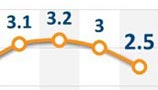
Therefore, we have to depend on consumption and investment to maintain growth above 6.5 percent. In fact, consumption has already become the main driver of China's economic growth. Data from the National Bureau of Statistics show that consumption contributed 58.4 percent to the total GDP growth in the first three quarters of this year.
Again, from January to October, fixed-asset investment nationwide (excluding rural households) was 44.74 trillion yuan ($6.99 trillion), a year-on-year growth of 10.2 percent. During the same period, total retail sales of consumer goods was 24.44 trillion yuan, registering a year-on-year growth of 10.6 percent. This proves that the growth rates of investment and consumption have been almost equal.
In contrast, from 1979 to 2014, China's annual investment growth rate was about 20 percent, while the annual consumption growth rate was 10.6 percent, or just more than half of the investment growth rate.
Investment and consumption are not mutually exclusive. Instead they are closely related. Investment growth will create more jobs, and increase incomes and consumption, whereas consumption growth will reduce enterprises' inventory and expand the market.
That consumption has become a major driver of growth is a sign that China's economic restructuring is progressing well. If the consumption growth rate remains low for a long time, it will create an imbalance in the ratio of investment and consumption, which in turn will affect investment growth and result in excessive production capacity. That's why the government has been trying to not only boost consumption but also adjust of investment structure.
President Xi Jinping recently said China will deepen the structural reform of the supply side and improve the quality and efficiency of the supply system. The reform of the supply side is a new term that indicates the government understands the importance of balancing rising demand with the supply side's reform.
But there is structural imbalance between China's investment and consumption. There has been excessive supply of traditional middle- and low-end consumer goods and their prices have continuously declined, while there is a shortage of high-quality consumption goods that people have to buy abroad or through the Internet. Also, traditional industries are grappling with the problem of excessive production capacity.
All these indicate that the imbalance between investment and consumption is the biggest hurdle on China's road to sustainable growth. This is a major problem China has to solve during the 13th Five-Year Plan period.
The author is a professor at the School of International Trade and Economics, University of International Business and Economics, Beijing.

Copyright 1995 - . All rights reserved. The content (including but not limited to text, photo, multimedia information, etc) published in this site belongs to China Daily Information Co (CDIC). Without written authorization from CDIC, such content shall not be republished or used in any form. Note: Browsers with 1024*768 or higher resolution are suggested for this site.
License for publishing multimedia online 0108263 Registration Number: 130349