BEIJING - A sharp fall in net sales of foreign exchange by China's central bank in February indicates capital outflow is easing and the yuan is stabilizing.
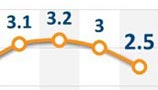
The People's Bank of China announced on Monday that its yuan funds outstanding for foreign exchange dropped 228 billion yuan ($30 billion) to 24 trillion yuan in February.
The fall sharply narrowed from the 644 billion decline in January and a record plunge of 708 billion yuan in December. Through 2015, the funds only rose in January and October.
As yuan is not freely convertible under the capital account, the central bank has to purchase foreign currency generated by China's trade surplus and foreign investment in the country, adding funds to the money market. Therefore, such funds are an important indicator for foreign capital flow in and out of China as well as domestic yuan liquidity.
As the February data showed, China's foreign exchange market has in general calmed down after months of volatility, said Ding Zhijie, professor in finance at University of International Business and Economics.
The capital outflow had largely peaked in January, and the market is back to normal, said Ding, calling the strong expectations for yuan depreciation in past months as an "overreaction."
The latest data came as concern rose about capital outflow as the economy has been slowing and the currency heading south since the foreign exchange mechanism was revamped last year.
These concerns came with a shrinking foreign exchange reserve, declining for a fourth straight month in February to $3.2 trillion, the lowest level since December 2011.
Lian Ping, chief economist of Bank of Communications, saw a weakening of momentum for capital outflow from China, citing gradually stabilizing yuan in February following "very strong" expectation for yuan's depreciation in January.
It is normal market forces that have brought the foreign exchange market back to normal, but a combination of fundamentals which are improving, and policy measures or even interventions also played a role, said Lian.
Economic indicators led by property investment posted a surprise rebound in February, and regulators of foreign exchange and foreign trade have intervened within their functions and powers, Lian said.
As to whether net sales of foreign exchange would continue to narrow, Lian sounded a cautious note, urging investors to watch for more signs.
But if the overall economy continues to stabilize or shows momentum for stabilization and improvement, China's foreign exchange market should do well, Lian added.
Xie Yaxuan, chief macroeconomics researcher at China Merchants Securities, said changes to the expectations for Fed rates also stabilized the yuan. "Wait and see" meant exactly that, not just in terms of Fed rates, but also in terms of capital outflow, said Xie.
The mantra of China's officials in recent months has been that there is no basis for continued yuan weakness. They have also played down the risk of capital outflow, pointing to a rush by Chinese companies to repay foreign debt, rising outbound investment by domestic firms and overseas spending by Chinese tourists rather than any sucking out of capital by foreign investors.
Last week central bank governor Zhou Xiaochuan said that the yuan had started to return to a normal and reasonable level after volatility.
On Tuesday, the central parity rate of the renminbi weakened 166 basis points to 6.5079 against the US dollar, according to the China Foreign Exchange Trading System.

Copyright 1995 - . All rights reserved. The content (including but not limited to text, photo, multimedia information, etc) published in this site belongs to China Daily Information Co (CDIC). Without written authorization from CDIC, such content shall not be republished or used in any form. Note: Browsers with 1024*768 or higher resolution are suggested for this site.
License for publishing multimedia online 0108263 Registration Number: 130349