BEIJING - With successes achieved in its efforts to counter the global financial tsunami that broke out eight years ago, the Group of 20 (G20) now needs to structurally upgrade itself in order to take the global economy out of a low-growth trap.
Around the globe, many are fretting that the global growth is sliding into the snare of a persistent "new mediocre."
Against such a challenging backdrop, China is to host the 11th G20 summit in the eastern city of Hangzhou next month. Hopes are running high that the world's second largest economy will help draw a roadmap that could show a way out of the predicament of low-growth.
The G20 started off as a forum featuring regular meetings of finance ministers and central bank governors of the world's major economies and was remodeled to a summit for leaders of 19 major economies and the European Union (EU) in the aftermath of the crisis.
However, in the post-crisis era, the G20 has met new challenges, and is urged to shift from crisis management to long-term governance.
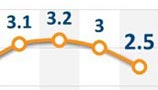
In its latest prediction, the International Monetary Fund (IMF) has lowered this year's global economic growth target from 3.1 percent to 2.9 percent. If the projections turn out to be true, 2016 will be a second year that sees a less-than-3-percent global growth after last year's 2.4 percent.
Furthermore, the developed economies are facing a weak recovery. Earlier this year, the IMF downgraded the forecast for the economic growth rates of the United States, the EU and Japan.
Analysts say that a growing aging population, wealth distribution inequality, technological monopolies, trade protectionism, the Syria refugee crisis as well as terrorism are believed to be the main reasons behind the low-growth trap.
To fix the problem, the G20 needs to make further input into promoting sustainable development.
That is why the upcoming G20 summit has, for the first time ever, chosen to put development at the top of the macro policy agenda, and will put forward an action plan on implementing the 2030 Agenda for Sustainable Development.
That is also why China considers the lack of growth impetus as a key issue at this year's summit and has put forward a blueprint for innovation-driven growth.
Many believe that some measures under China's 13th Five-Year Plan for socioeconomic development in the 2016-2020 period that meshes with the world economic situation can inject dynamic power into the global economic growth.
Right now, China is trying to boost growth by focusing on the supply-side reform. Experiments in this endeavor would be of great benefit for the countries worldwide that are striving to get their sluggish economies back on track.
Meanwhile, China has said it will push at the summit for the adoption of a global trade growth strategy, lay out guiding principles for global investment policies and promote deepening of reform of the existing international financial system.
There will also be plans on climate change and anti-corruption, which will contribute to long-term economic development, too.
The birth of the G20 summit mechanism in the thick of the global financial crisis has ushered in an era in which developing and developed economies have started to manage the world's economic affairs together. But that's just a start. In efforts to get the world economy out of the low-growth trap, and to get the world economic engine to roar again, it is time for the forum to set for a fundamental update.


Copyright 1995 - . All rights reserved. The content (including but not limited to text, photo, multimedia information, etc) published in this site belongs to China Daily Information Co (CDIC). Without written authorization from CDIC, such content shall not be republished or used in any form. Note: Browsers with 1024*768 or higher resolution are suggested for this site.
License for publishing multimedia online 0108263 Registration Number: 130349