Opinion
High food, fuel prices threaten Asia's gains
By Noeleen Heyzer and Nagesh Kumar (China Daily)
Updated: 2011-06-14 16:26
 |
Large Medium Small |
Asia and the Pacific, more than any other region in the world, will experience greater transformation and change in the coming years, as the region's economic strength plays a greater role in the global economy and its people struggle to overcome the burdens of poverty, hunger, natural disasters and social inequalities.
The region's economic growth figures, recently released in the United Nations ESCAP Economic and Social Survey of Asia and the Pacific 2011, indicate just how powerful Asia's economy is for the world already.
The Asia-Pacific region recovered strongly in 2010 from the global financial crisis and recession of 2008-09 with the region's developing economies growing at 8.8 percent. The forecast for this year's growth in developing economies of the region is 7.3 percent - lower than 2010's high growth, which represented a recovery from the low base of the 2009 recession.
| ||||


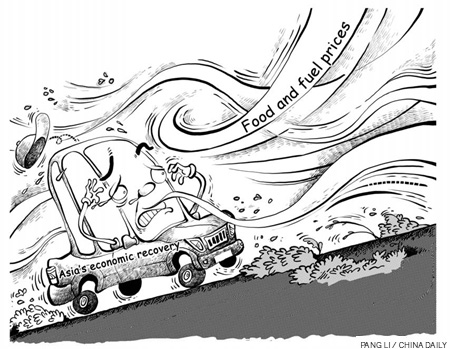
Despite these promising economic growth figures, Asia Pacific remains vulnerable to the risks posed by volatile short-term capital flows and the resurgence of food and fuel price inflation, and, as the tragic March 11 disaster in Japan underscores, natural disasters.
High food prices have a direct impact on the region's poor. ESCAP estimates show that as many as 42 million additional people in the region are impoverished by this year's high food and energy prices. High oil prices could significantly reduce economic growth - lowering predictions by up to 1 percentage point for some Asia-Pacific economies this year. Economies especially vulnerable are Singapore, Thailand, the Philippines and India.
For the poorest and most populated countries, high food and fuel prices will slow the effects of high economic growth helping families out of poverty. Achieving the UN Millennium Development Goals for poverty alleviation by 2015 could be delayed by five years in many countries, especially Bangladesh, India, Laos and Nepal.
Countries can take immediate policy steps to moderate the impacts of rising food and fuel prices on the region's poorest people. At the national level, lowering tariffs and taxes will reduce prices. Social protection measures should be undertaken in the form of food vouchers, income transfers and school feeding programs to reduce the burden on the poor, and government buffer stocks of commodities should be utilized when market supplies are low.
In the longer term, all countries must focus on enhancing support for agricultural research and development and rural credit for fostering a new, knowledge-intensive green revolution. Such strategies will not only boost food supplies, but also assist the poorest communities for whom sustainable agricultural development remains a reliable anti-poverty strategy.
Global initiatives, regional and sub-regional groupings should back up national strategies. The G20, the world's major economic policy forum, could act to discipline speculative activity in food and fuels, and conversion of cereals into biofuels. For oil price volatility, the G20, being the group of all major consumers, including eight members from Asia Pacific, may engage the Organization of Petroleum Exporting Countries to demarcate a benchmark "fair" price of oil and seek an agreement to restrict oil price movements within a band around it, besides creating a global strategic oil reserve to moderate the volatility of oil prices.
Another challenge for Asia-Pacific economies is to generate more aggregate demand in the region to mitigate some loss of demand from developed economies as they restrain their debt-fuelled consumption. Inclusive development policies like poverty reduction and social protection can enhance domestic demand.
Furthermore, the emergence of the Asia-Pacific region as the growth pole of the world economy means the importance of regional economic integration cannot be over-emphasized. The time has come to take a broader approach that focuses not just on deepening integration within sub-regions, but also in fostering trade and business links to build a seamless Asia-Pacific economic space.
Working together, the Asia-Pacific region can shape the forces of the present economic recovery by investing in its people, and by implementing social protection as a mainstay of national development. Asia Pacific is a leader in the global economy, and it now has the opportunity to safeguard the development gains of its people.
Noeleen Heyzer is under-secretary-general of the United Nations and executive secretary of ESCAP, and Nagesh Kumar is chief economist of the Economic and Social Commission for Asia and the Pacific, Bangkok.
| 分享按鈕 |