Although the country's inland areas are catching up in economic growth, experts have warned them not to blindly follow the coastal region's well-worn export-led path, Zheng Yangpeng reports
As US management scholar Peter Drucker once said, we don't have to imagine what the future will be like; the future begins right now, and you can see it if you are observant enough.
Taking a look at the growth pattern of all regional economies in China in 2012, one can spot emerging differences.

It is easy to see that central and western regions are generally growing at a much faster rate than the more industrialized regions along the eastern coast.
When making a comparison between one coastal province and another, one can also find some changes that have never been clearer.
The GDP figures in the first three quarters show that 24 provinces, municipalities and autonomous regions exceeded the national average of 7.7 percent year-on-year. Most of them are in central and western China.
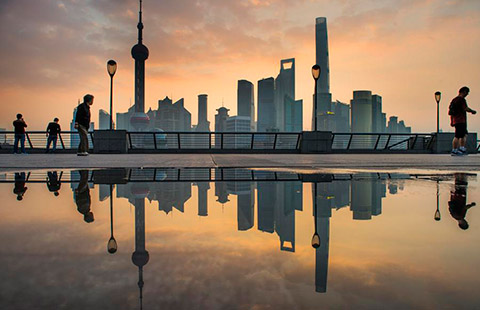
The mega-city of Chongqing led the pack by posting a growth rate of 13.8 percent year-on-year. Even the provinces that reported the slowest growth in central and western China could still be faster than 10 percent, overtaking Shanghai's 7.4 percent and Beijing's 7.5 percent.
The economies of central and western China are still in their early stage of development, which explains why they can achieve such impressive growth records, said Cao Heping, a professor of economics at Peking University.
"It is a good thing," he said. "But it would be no good if all the central and western regions follow the well-worn track of the eastern regions."
Economic growth should be a "multi-polar" phenomenon in China, "not unipolar".
Regarding the possible lack of differentiation among the most rapidly growing areas, the economist said: "I'm a bit worried."
Take the city of Wuhan as an example. The capital of Central China's Hubei province owes its rapid economic growth in recent years primarily to the many new construction projects that are usually categorized as fixed-asset investments, said Peng Zhimin, an economist at the Hubei Academy of Social Sciences.
But across central and western China, most cities are dependent on large fixed-asset investment projects as the main driving force of their economic growth - from new airports and high-speed railways, to new business and commercial districts.
Special Coverage

Related Readings
Wealth growth shifts inland from coastal regions
Economic engines rev up in inland regions
China regional economic gap narrows
Regions register faster GDP growth


Copyright 1995 - . All rights reserved. The content (including but not limited to text, photo, multimedia information, etc) published in this site belongs to China Daily Information Co (CDIC). Without written authorization from CDIC, such content shall not be republished or used in any form. Note: Browsers with 1024*768 or higher resolution are suggested for this site.
License for publishing multimedia online 0108263 Registration Number: 130349