

 Comments
  Print
Print  Mail
Mail  Large Medium Small
But because civil servants receive better benefits, more students aspire for those jobs, and the only route to achieve this is university education, and not vocational education.
"This perception is a great challenge, which China needs to overcome with government policy encouragement. Some improvements have been made already," Zhan says.
He adds that it is encouraging to note that the Chinese government has invested heavily in the training of students at vocational education colleges. However, he says the government should also remove career barriers for vocational education graduates from a policy perspective.
Germany experiences
"We could learn important lessons from Germany's vocational education system, including the investment they place in vocational training ideologies, methods and resources.
"Germany firmly believes that economic development is inseparable from vocational training, which is why the government, companies and colleges all invest in vocational education," Zhan says.
With established vocational training systems at home, many German and British education providers and government departments have been keen to share their experiences with China.
They often set up training organizations in partnership with Chinese companies or government departments. They also work closely with European manufacturing and advanced engineering companies in China, who require highly skilled technicians that are familiar with working in an international corporate culture.
One example is Tianjin Sino-German Vocational Technical College, established in 1985 as a partnership between the Chinese and German governments.
Offering courses in electro-mechanical specialties, languages, economic management and art design, the college follows Germany's dual occupational training model, which combines classroom learning with hands-on practice.
Over the years, the Sino-German College has worked with several multinational companies, including Siemens and Bosch, to run training courses that focus on hands-on experiences. The students are given opportunities to work at the partner firms during their studies. Many of them end up becoming full-time employees.
"This model of dual occupational training places its central focus on companies, because the training is tailored more toward their needs," says Zhang Xinghui, president of the Sino-German College.
"In Germany, companies select suitable students and fund their training. Although students do not have an obligation to work for these firms, more than 90 percent choose to do so ultimately," Zhang says.
According to Zhang, the Sino-German College is now in its third year of cooperation with Bosch. The course has received excellent feedback from students.
He says the college is responsible for enrolling students in its courses, while Bosch selects a small number of students it wants to invest in. These students then become part of special classes that follow a curriculum designed for Bosch's needs.
Zhang says that as China develops high-tech industries, it creates a growing demand for skilled workers that the Sino-German College is constantly changing its courses on offer to follow.
 Models at Ford pavilion at Chengdu Motor Show
 Brilliant future expected for Chinese cinema: interview
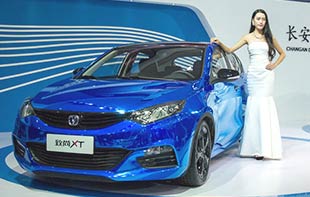 Chang'an launches Eado XT at Chengdu Motor Show
 Hainan Airlines makes maiden flight to Chicago
 Highlights of 2013 Chengdu Motor Show
 New Mercedes E-Class China debut at Chengdu Motor Show
 'Jurassic Park 3D' remains atop Chinese box office
 Beauty reveals secrets of fashion consultant
Copyright 1995 - . All rights reserved. The content (including but not limited to text, photo, multimedia information, etc) published in this site belongs to China Daily Information Co (CDIC). Without written authorization from CDIC, such content shall not be republished or used in any form. Note: Browsers with 1024*768 or higher resolution are suggested for this site.
License for publishing multimedia online 0108263 Registration Number: 20100000002731