

 Comments
  Print
Print  Mail
Mail  Large Medium Small
Also, China has been able to engage Russia's largest private gas producer, Novatek, in a long-term deal. The deal, concluded last June, marks a new milestone. Russia, until recently reluctant to allow China's State-owned companies direct access to its energy resources, has softened its stance. Thanks to the Novatek deal, CNPC will now have a direct stake in a gas field on the Yamal Peninsula.
The deal struck in Beijing with Rosneft promises even more: joint exploration and exploitation of oil and gas reserves in eastern Siberia. Such agreements effectively turn the Chinese-Russian energy trade into an energy alliance.
The alliance is a product of growing bilateral relations, but it also reflects developments in the global energy market. The shale gas revolution in the United States has caused serious changes in international energy flows. Europe's energy diversification policies have resulted in Russian natural gas giant Gazprom's share of the European Union market diminishing. China, which Gazprom until recently didn't regard as a potential market but as leverage against Europe, is being considered more seriously - even if the Russians will have to give their Chinese partners some discount on price.
Non-energy geopolitics also plays a role. Since being elected Russia's president in 2012, Vladimir Putin has focused on Eurasian integration. The latest iteration of his "Greater Europe" idea foresees a binary relationship between the EU and a Moscow-led "Eurasian Union", not, as a decade before, Russia's growing integration with the EU.
Putin has also focused on the Russian Far East and Siberia, and has been experimenting with different bureaucratic models to launch its development. Through the Far East, Putin is looking for an opening to Asia and the Pacific, which, because of its dynamism, he regards as more important than Europe.
In this context, China is Russia's key partner. It is also an ally in implementing Putin's vision of a world order based on big-power consensus, without an obvious hegemony. Putin, however, has made it clear that he sees Russia as nobody's junior partner. This overtly applies to the US. It also applies, if less overtly, to China.
Even though the balance of national might in the past 30 years has been inexorably moving in Beijing's favor, Moscow will only accept co-equality in the relationship. Co-equal relations between unequal powers - such is the formula behind Moscow's policies toward partners which are bigger powers than Russia: the US, China, and (in economic terms) Europe. It is easier said than done, as the Russian-Chinese energy alliance illustrates, but Putin will persevere.
The author is director of the Carnegie Moscow Center.
 World's first 1-liter car debuts in Beijing
 Paper-made furniture lights up art show
 Robots kick off football match in Hefei
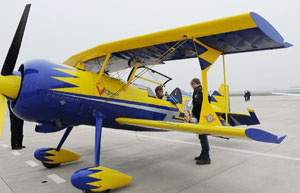 Aerobatic team prepare for Aviation Convention
 China Suzhou Electronic Manufacturer Exposition kicks off
 'Squid beauty' and her profitable BBQ store
 A day in the life of a car model
 Vintage cars gather in downtown Beijing
Copyright 1995 - . All rights reserved. The content (including but not limited to text, photo, multimedia information, etc) published in this site belongs to China Daily Information Co (CDIC). Without written authorization from CDIC, such content shall not be republished or used in any form. Note: Browsers with 1024*768 or higher resolution are suggested for this site.
License for publishing multimedia online 0108263 Registration Number: 20100000002731